Michelle Golder Michelle Golder

Reflections on Our Screening of the People's Emergency Briefing on 5 July 2026 (During a Heatwave)

A personal response to the group’s screening of the People’s Emergency Briefing Film.
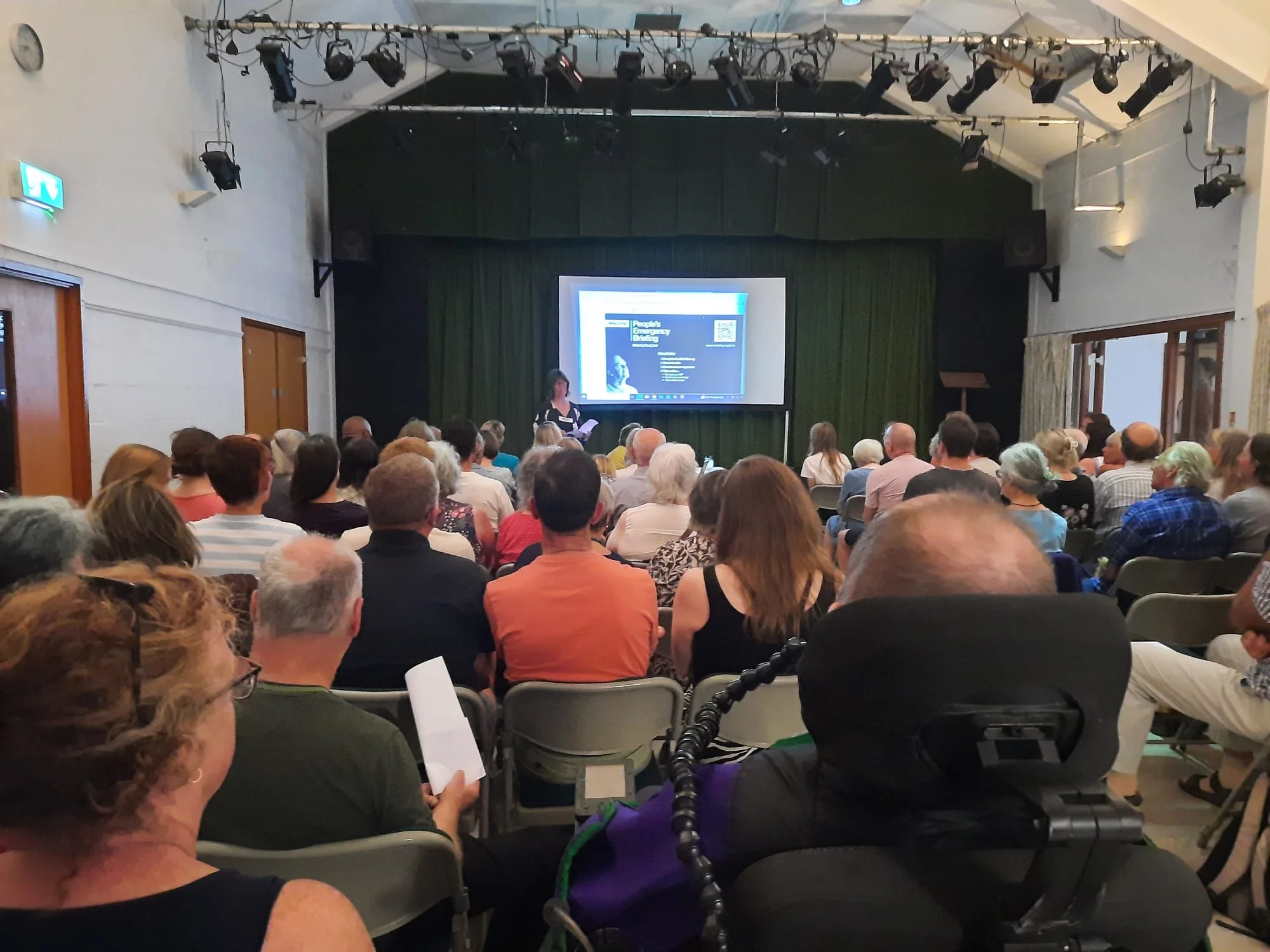
A woman stands in front of a screen addressing a packed audience in a village hall.

Just one week before our group screened this film at Haslingfield Village Hall, the government responded to a (still live) petition, which arose from the thousands of screenings like ours across the UK, asking for a televised public briefing on the emergency. That response, written by DEFRA and which you can read here, said that the campaign is right to highlight climate change as a major threat. They agreed that “nature and a stable climate underpin our health, economy, national security and critical services.” They also committed to a new “public statement” this summer - their second statement on the subject. The first, called the State of Climate and Nature, came out in July 2025, and they say it got lots of coverage. Do you remember that?

Neither did I, and that’s why it worries me that instead of agreeing to a public briefing, to include all the information in the film, the response dodged the question and sought to reassure us with something called Adverse Weather Health Plans and new food waste and recycling schemes. Don’t get me wrong, those are good steps. But it still seems that the government is acknowledging an emergency while declining to communicate it as such to citizens. That's precisely why people like us matter. But how?

The film brought a lot of information together into one hour. It’s hugely impactful and from the discussion afterward I think most of the people there felt that impact. But I also suspect most of them already knew at least the outlines of what this film had to say. As Chris Packham said, 83% of us consider climate action urgent. So what the film gave me, especially on this second viewing, isn't primarily information. It's the experience of knowing this together, in a room, with other people. And that is rarer and more important than it might sound, because we live in a culture that has become very good at keeping this knowledge private. We carry it individually. We manage it individually. We imply that it's an individual problem of behaviour change or better choices. We have almost no shared language for it in ordinary life — at work, at school, and perhaps even at home.

But even sharing that knowledge with others isn’t enough. For me it feels imperative that we get from information to action. And again, we’re better off doing that together. The writer Rebecca Solnit tells the story of being at an event in Paris during the climate treaty negotiations, sitting on the floor with science writer Bill McKibben, when someone came up and asked him "What's the most effective thing I can do as an individual?" McKibben replied: "Stop being an individual. Find something to join. Join an organisation, a movement, a campaign. Find a community."

This was literally the first step I took when I decided to “do something”. I researched what was already going on in Cambridge. And that’s even easier now that we have a Cambridge Resilience Web site where you can find in one place all the local organisations working on climate, food, equality, reducing waste, nature restoration, plastics, etc. etc. Many of them would love your volunteer energy or, if that’s not possible, your financial or “getting the word out” support.

But we can also make use of the communities we are already part of. In Haslingfield, our parish council is already trying to be part of the solution, as are this and many other groups and individuals locally (check out our WhatsOn and Projects pages to see what we are doing). Maybe you can form your own new action group with your friends and neighbours – a car sharing, or walking to school, or plastics reduction group. Maybe that can start with attending our follow up get together on Sunday July 19th, at Wisbey’s Yard Community Room, CB23 1NF, from 6 to 7.30pm. Anyone who has seen the film or the full public briefings on YouTube is welcome. Do please let us know if you plan to come by writing to hnheco@gmail.com.

On the night, there were several comments from the audience that expressed feelings close to despair. Weirdly, after 11 years working and learning in this space, I have been feeling more optimistic lately. There is no doubt our situation is dire and dangerous, and there are consequences we now cannot stop – but the UK has weathered dangerous times before, with a spirit that I’m sure we still have within us. I don’t know what the one big beautiful solution is – I don’t think there is one – but I know that the only thing that guarantees a bad future is failing to act now. We can make a difference — a real one — that could contribute to something beautiful eventually. But we have to get to work.

PS: The filmmakers responded to the government's response, by the way (see it here).  Key takeaway: "The government's response lists a range of reports, plans and strategies. These are valuable documents, but they are not a substitute for clear public communication. The central issue is not whether information exists, but whether it is reaching the public." 


Read More
Michelle Golder Michelle Golder

Village Life – Stronger Than We Think?

How village life increases community resilience.

This May saw Haslingfield’s Parish Council do something different for their Annual Public Meeting – instead of an invited speaker, they asked representatives of all the parish’s groups and societies to give little presentations of what we all do. Harlton already does this every year, and H&H Eco were invited to speak at both. I found it all very inspiring – there is so much, from the Parish Councils themselves to the Brownies, from the Little Theatre to the Community Car Scheme, from the Connexions Youth Bus to the Allotments, from the Gardening Club to the Cricket, going on in our villages! And almost all of it organised and carried out by volunteers. Add in our shop and café, the community owned Hare and Hounds, the pop-up coffee shop run by the Methodist Church, and now the monthly Haslingfield Market, and we can honestly say we are holding onto, and maybe even improving, our self-sufficiency as a community. And this feels very important to me right now. The government has recently released two reports highlighting our vulnerability as a nation to global events – like climate change and ongoing conflicts – which threaten our security. The Fourth Climate Change Risk Assessment, released May 2026, warns that “the British way of life is increasingly at risk from escalating heat, flooding and drought… without stronger action, overheating homes, rising river flows and severe water shortages will intensify by mid‑century.” While the December 2025  Defra Food Security Report highlights risks to our food system, such as climate change, biodiversity loss, and reliance on imports. It emphasizes the need for increased resilience in the food system to ensure sustainable food production for the future.

All the groups in the village, whether they provide amenity or practical services, bring people together, or just help people live satisfying and sustainable (in the widest sense of that word) lives, are doing their bit to increase resilience – our ability to cope with the risks we face over the next months and years. That’s our focus too, and we are especially proud of the help we are able to provide to groups like the Little Owls (helping with the excess from their Jumble Sales, and inviting them to provide fundraising refreshments at some of our events), the Scouts and Cubs (running biodiversity sessions) and the Parish Councils (providing research and policy advice and volunteers to help with some of the green spaces). All of our events have resilience in mind – whether its helping people to learn new skills like scything (useful when petrol prices rise!), or to access repairs for their small appliances with our annual repair café. These things show us that we are not helpless, despite threats to democracy or the natural world. There are so many skills and so much ability in our own little sphere. So do join us at one of the wonderful events we have coming up and celebrate our community resilience! You can find out about all our events on our Whats On pages: https://www.hheco.co.uk/whatson

Read More
Information and education Michelle Golder Information and education Michelle Golder

Podcasts and Substacks I Recommend

What co-chair Michelle Golder has been listening to and reading…

from co-chair Michelle Golder…

Planet Critical

Hosted by young Scottish journalist Rachel Donald. “With 34,000 subscribers in 188 countries, the Planet: Critical podcast and newsletter investigate how our energy, economic and political crises are colliding, to reveal what’s really going on—and what needs to be done.” https://www.planetcritical.com/

Outrage + Optimism

“We cover the latest news from science, business, finance politics and culture every Thursday with a can-do attitude. This podcast is for everyone looking to expand their understanding of the climate crisis and get inspired to take action.

Like you, we are outraged that it's taken so long to act on climate change at the scale necessary – despite ongoing warnings from scientists, economists and many other experts.

Outrage + Optimism’s energetic hosts Christiana Figueres, Tom Rivett-Carnac and Paul Dickinson, and their brilliant guests share expert opinions along with healthy doses of both outrage and optimism that will leave you feeling informed and energised.” https://www.outrageandoptimism.org/

The Crucial Years - Bill McKibben’s Substack

Bill McKibben is an American author, educator, and environmental activist; a founder of 350.org and Third Act. He writes from a hugely informed, relentlessly optimistic but also highly realistic perspective. https://substack.com/@billmckibben

Philosophise this!

Stephen West is a very good explainer of philosophical concepts and has covered some fascinating modern philosophical thinkers whose ideas seem so relevant to the environmental predicament. https://www.philosophizethis.org/podcast

The Great Simplification with Nate Hagens

Nate Hagens is the Director of The Institute for the Study of Energy & Our Future (ISEOF) an organization focused on educating and preparing society for the coming cultural transition. His theory that we are at the end of a “carbon pulse” which provided the vast amounts of energy to which we owe much of modern civilisation is compelling – and his thoughts about what we can do at the end of that pulse are interesting. https://www.thegreatsimplification.com/

Read More
climate change Michelle Golder climate change Michelle Golder

The Visible Catastrophe

Something happened yesterday morning that deserves more attention than it will probably get. In the pre-market hours in New York, before any public announcement had been made, someone placed two enormous bets on the financial markets. One — worth $1.5 billion — wagered that stock prices would rise. The other — $192 million — wagered that oil prices would fall. Fifteen minutes later, President Trump posted on Truth Social that the United States had been holding "very good and productive conversations" with Iran, and that planned military strikes would be paused for five days.

The markets moved exactly as those bets had predicted. The oil position alone generated an estimated $100 million in profit within twenty minutes. The equity gains pushed the total considerably higher.


This is the moment to stop and ask ourselves a question: are we simply choosing not to see what is directly in front of us?
Something happened yesterday morning that deserves more attention than it will probably get. In the pre-market hours in New York, before any public announcement had been made, someone placed two enormous bets on the financial markets. One — worth $1.5 billion — wagered that stock prices would rise. The other — $192 million — wagered that oil prices would fall. Fifteen minutes later, President Trump posted on Truth Social that the United States had been holding "very good and productive conversations" with Iran, and that planned military strikes would be paused for five days.

The markets moved exactly as those bets had predicted. The oil position alone generated an estimated $100 million in profit within twenty minutes. The equity gains pushed the total considerably higher.

There was just one problem. Iranian Parliament Speaker Mohammad Bagher Ghalibaf flatly denied any negotiations had taken place, calling Trump's announcement "fake news used to manipulate the financial and oil markets."1 Iran's Foreign Ministry confirmed there had been no direct or indirect contact with Washington at all.

Someone made $100 million in twenty minutes on a presidential announcement that the other country involved said never happened.

The Securities and Exchange Commission has not commented. The CFTC has not announced an investigation. The White House called the allegations baseless. And the news cycle has already moved on to the next crisis.

This is the moment to stop and ask ourselves a question: are we simply choosing not to see what is directly in front of us?

✦ ✦ ✦

There's a Pattern Going On Here

This was not an isolated event. Traders and hedge fund managers have noted multiple instances in recent months where very large, very precisely timed bets have preceded major US government announcements. Similar concerns have arisen around prediction markets, where suspiciously well-informed wagers have appeared ahead of US actions involving countries including Iran and Venezuela.2

There is also the matter of who is connected to those prediction market platforms. The New York Times has reported that leading prediction market firms share a notable commonality: Donald Trump Jr.3,4

The pattern, taken whole, is not subtle. A president makes announcements — sometimes apparently false ones — that move markets in predictable directions. Immediately before those announcements, people with what appears to be advance knowledge place bets that profit from exactly those movements. The institutions responsible for investigating such behaviour are led by appointees who serve at the pleasure of the president himself.

What the evidence shows

Trump's Iran ceasefire announcement came two hours before US markets opened, and the five-day pause he announced ends precisely at the close of the energy trading week — a detail Iranian analysts were quick to highlight.

Iran's parliament speaker said: "Every week, when markets open, Trump makes these kinds of statements to drive down oil prices." Iran's Foreign Ministry confirmed there had been no negotiations, directly or indirectly.

The trades preceding the announcement were described by multiple hedge fund managers as "highly unusual." No regulatory investigation has been announced.

The most straightforward explanation — the one that fits all the known facts about this president's character, history, and the people around him — is that personal enrichment is at or near the centre of his decision-making, and that associates with advance knowledge of his announcements are profiting from them. Whether that is the actual explanation requires an independent investigation to determine.

There is no independent investigation.

✦ ✦ ✦

Why Is Nobody Stopping Him?

This is the question making us all crazy. And there are two levels of answer to it. The first level is about the current political situation.

He controls the enforcement mechanisms. The DOJ, the SEC, the FBI, the CFTC — all now answer, directly or indirectly, to the president. Investigating him would require institutions he controls to act against him. This is not accidental. It is the outcome of a sustained effort to place loyalists in every position of institutional authority.

The Republican Party has stopped functioning as a check. Individual Republicans who should know what Trump is have made a rational calculation: personal survival requires silence. The result is that one of the fundamental mechanisms of democratic governance — opposition within the system — has effectively ceased to operate.

The courts are slower than the damage. Legal challenges take years. By the time rulings arrive, the profits have been made, the norms have been broken, and the next outrage is already dominating the headlines.

The volume of wrongdoing is itself a weapon. When scandals arrive faster than public attention can process them, the effect is not outrage but exhaustion. There is substantial evidence that this effect, in authoritarian political movements, is not accidental. Overwhelmed people disengage. Disengaged people don't resist.

The greatest danger, alongside the physical reality, is the psychological retreat into helplessness that prevents even the damage-limitation that remains possible.

Historians who study democratic backsliding note one consistent feature: it almost always happens faster than people expect, and by the time the majority recognises it fully, the mechanisms for correction have already been significantly weakened. We are living through a case study in real time.

✦ ✦ ✦

This Didn't Come From Nowhere

The second level requires us to zoom out, but hold the Iran trades in your mind for a moment longer first, because they illuminate something beyond the ordinary question of possible self-serving. A man with the power to move global oil markets made an announcement that enriched people around him. That same man has used every lever of power to undermine climate action and information, both in the US and globally. The market manipulation and the climate obstruction are not two separate scandals. They are expressions of the same underlying logic: extract maximum value from carbon, for as long as possible, regardless of the cost to anyone else. And it's not a coincidence he is pursuing this agenda now.

The period between roughly 2025 and 2035 is considered by many climate scientists to be the last window in which aggressive action could still meaningfully limit the degree of environmental catastrophe — prevention is most likely no longer possible.

Yet combatting climate change represents the single greatest threat to the profits of the fossil fuel industry — the wealthiest and most politically connected industry in human history. As the science became undeniable and public pressure for action grew through the 2010s, the stakes for that industry became existential. When your entire business model is threatened, you don't quietly accept it. You fight back with every tool available.

The tools available to people with hundreds of billions of dollars are considerable. This is not conspiracy theory — it is documented history. ExxonMobil's own scientists understood climate change from the 1970s. Rather than act on it, the company funded decades of deliberate disinformation.5 The Koch brothers built an entire political infrastructure specifically to block climate legislation. Dark money networks poured billions into think tanks, political campaigns and media outlets designed to manufacture public doubt.

These same networks were instrumental in Trump's political rise.

And here is where the Iran oil trades connect back to all of this. Every false announcement that knocks dollars off a barrel of oil, every market-moving tweet, every crony appointment that further disables the institutions meant to investigate it — these are not just personal grifts. They are also, functionally, acts of climate obstruction. A president who has learned he can move energy markets with a social media post has every incentive to keep energy markets — and therefore global attention — focused on oil. Not on the transition away from it.

Meanwhile, Russia's entire economy runs on fossil fuel exports. A world that successfully transitions to clean energy is an existential threat to Vladimir Putin's power. He therefore has enormous motivation to fund and amplify the political forces in Western democracies that resist climate action — and there is substantial evidence he has done exactly that, through disinformation campaigns, funding of far-right parties, and election interference.

The alignment between Trump, the fossil fuel lobby, and Putin on climate is not coincidental. They all benefit from the same outcome: delay, denial, and the continued dominance of carbon-based energy. Trump isn't the cause of all this, he's just the perfect instrument to carry out this agenda — a man with no ideology beyond self-enrichment, and no inconvenient principles to navigate around. And he is doing this at precisely the moment it matters most — the period that climate scientists consider the last window for meaningful action.

✦ ✦ ✦

The Question Nobody Wants to Answer

Which brings us to the hardest question of all. Given the seeming erasure of all climate action, science and information by one of the world's largest emitters, and given that the consequences are already unfolding — is it too late? Are we heading for civilizational collapse?

The honest answer, on climate at least, is: too late to prevent serious harm, yes. The 1.5°C target of the Paris Agreement is effectively gone. We are on course for somewhere between 2.5°C and 3.5°C of warming under current policies, with the range of uncertainty extending higher. Several feedback loops — Arctic methane release, Amazon dieback, ice sheet destabilisation — are either already triggered or approaching their tipping points.

Civilisational collapse, in this context, doesn't necessarily mean human extinction. It means the end of the stable, predictable world that complex modern societies depend upon. Mass displacement. Food system failures. Water scarcity affecting billions. Political breakdown in vulnerable regions, leading to conflicts that make current wars look minor. The gradual erosion of the conditions that make interconnected civilisation possible.

Much of this is not a future scenario. It is already happening — to people in the Global South, in low-lying coastal regions, in areas of chronic drought. It is happening now. It is simply not yet happening to enough people in wealthy northern countries in ways they cannot ignore or insulate themselves from.

The darkest calculation

Some of the people funding and enabling Trump are not merely indifferent to climate change. They are old, extraordinarily wealthy, and appear to have concluded — perhaps consciously, perhaps not — that they will be dead before the worst consequences arrive, that their wealth will insulate them from much of what does arrive in their lifetimes, and that the profits available between now and catastrophe are worth extracting regardless of the cost to everyone else.

A rational, if monstrous, calculation.

✦ ✦ ✦

What Remains Worth Saying

Every fraction of a degree of warming still prevented matters enormously — the difference between 2.5°C and 3.5°C is the difference between very bad and potentially unsurvivable for large parts of humanity. The clean energy transition is happening rapidly in China, the EU, and elsewhere regardless of Washington. Massive efforts to restore nature's carbon sinks (forests, oceans, peat, meadows) are taking place. Local resilience matters even when global coordination fails.

And there is this: the resistance to action is not evidence that humanity as a whole has chosen this path. It is evidence that a relatively small number of extraordinarily powerful people have successfully manipulated democratic systems to protect their interests. That is a different problem — and in principle a more solvable one — than humanity being collectively suicidal.

But that solution requires people to see the situation clearly, name it accurately, and refuse the temptation of either false comfort or paralysing despair.

We know what is happening. We know who is doing it, and why, and roughly who is paying for it. The question that remains — the only question that matters now — is whether enough people are willing to say so plainly, loudly, and without waiting for permission.

Come and see it for yourself — then let's talk

If this piece has left you wanting to do something rather than simply absorb more bad news, we'd love to see you at a local screening of a remarkable film.

Last November, 1,200 politicians and community leaders gathered in Westminster for the People's Emergency Briefing — nine leading experts speaking honestly about climate, nature, food security, health, energy, tipping points, weather extremes and national security. Opened by naturalist Chris Packham and chaired by writer Mike Berners-Lee, the event was organised by Simon and Nick Oldridge of the Climate Science Breakthrough project, with Ben Casey and Henrik Delehag of the Utopia Bureau. A feature-length film of the day has now been made.

Screenings are taking place in communities around the country — not just as film nights, but as facilitated spaces for people of all backgrounds and political views to engage seriously with the evidence, reflect on what it means for their lives and communities, and connect with others locally around the question of how society responds. The wider aim is to build the public and political momentum needed to bring this briefing to television.

We are hosting a screening on Sunday 5 July, 6.30–9.00pm, at Haslingfield Village Hall. Everyone is welcome — especially people who don't normally come to climate events. Head to our What's On pages for details and to book your place.

Notes & Sources

  1. Iranian Parliament Speaker Mohammad Bagher Ghalibaf, posting on X, March 23, 2026, as reported by Al Jazeera: Iran denies any talks with US after Trump claims 'productive' discussions. Iran's Foreign Ministry spokesman Esmaeil Baghaei separately confirmed no direct or indirect dialogue had taken place. The IRGC described Trump's announcement as "psychological operations."
  2. NPR, January 2026: How Kalshi and Polymarket prediction market traders make money. Polymarket faced intense criticism after users made substantial bets ahead of the US military action in Venezuela. The trader's identity has not been publicly confirmed.
  3. Donald Trump Jr. joined Kalshi as a paid strategic adviser in January 2025, and later invested in rival Polymarket through his venture capital firm 1789 Capital, joining its advisory board. Both CNN and Reuters have reported on these arrangements. See: CNN, March 2026; Front Office Sports, August 2025.
  4. The New York Times, January 15, 2026: reporting on Donald Trump Jr.'s connections to the leading prediction market platforms.
  5. ExxonMobil's internal scientists accurately predicted the trajectory of climate change from the 1970s onward. Investigative reporting by InsideClimate News (2015) and the Los Angeles Times (2015) first documented this in detail, drawing on internal company documents. ExxonMobil subsequently funded external efforts to cast doubt on the science. Several US state attorneys general have pursued legal action on this basis.
Read More
politics, climate change Michelle Golder politics, climate change Michelle Golder

Greater Cambridge Development Corporation Consultation Response

A response to the Greater Cambridge Development Corporation Consultation which argues that growth must be within our planetary boundaries now and must contribute to more and better democratic engagement, not less.

Click on the title to read.
The government recently announced its proposal to set up a new body, the Greater Cambridge Development Corporation, stating that this is necessary to realise the potential for growth in this area. There is a consultation process, open until 1 April, so do have your say about this proposal which has huge implications for the future of our region.

According to the consultation document: “ Sustained economic growth is the only route to improving the prosperity of our country and the living standards of working people”. But what sort of growth, and will it be sustainable in the long term? I volunteered, within the Climate Leaders Group I belong to, to draft a response to the consultation. I did this by uploading a number of references which I thought were relevant to Claude.ai (a more ethical AI choice) and asking it to find more where I didn’t have evidence to support an argument. In the end we used 23 references, most of which are peer reviewed, and all of which are worth reading - if I couldn’t find evidence for a contention it is not included. I also gave the AI instructions about the main ideas I wanted to get across in my response: that growth must be within our planetary boundaries now and must contribute to more and better democratic engagement, not less. After 12 versions, in which I checked and edited every paragraph, I asked the AI to argue against my points, so that I would be more aware of what those with other points of view might think. This revealed where my arguments were weak or needed more support.

The final version, version 13, is linked below. This version has been shared widely, with the Climate Leaders and at the recent South Cambs Climate and Nature meeting with MP Pippa Heylings, where it was highlighted as one of the questions for her to address. She was complementary about the response, and addressed it thoughtfully, including revealing that her party, the LibDems, was involved in a process of re-evaluating how they wanted to define growth. It will be interesting to watch how that develops. A number of other community groups have also been in touch with me, wanting to build on or use the response as a reference. The version below is written as an email submission, but I have also created a version which is mapped to the consultation questions. I am happy to share either version - write to hnheco@gmail.com if you are interested.

Michelle Golder, co-chair


Greater Cambridge Development Corporation Consultation Response

Read More
Behaviour Change Michelle Golder Behaviour Change Michelle Golder

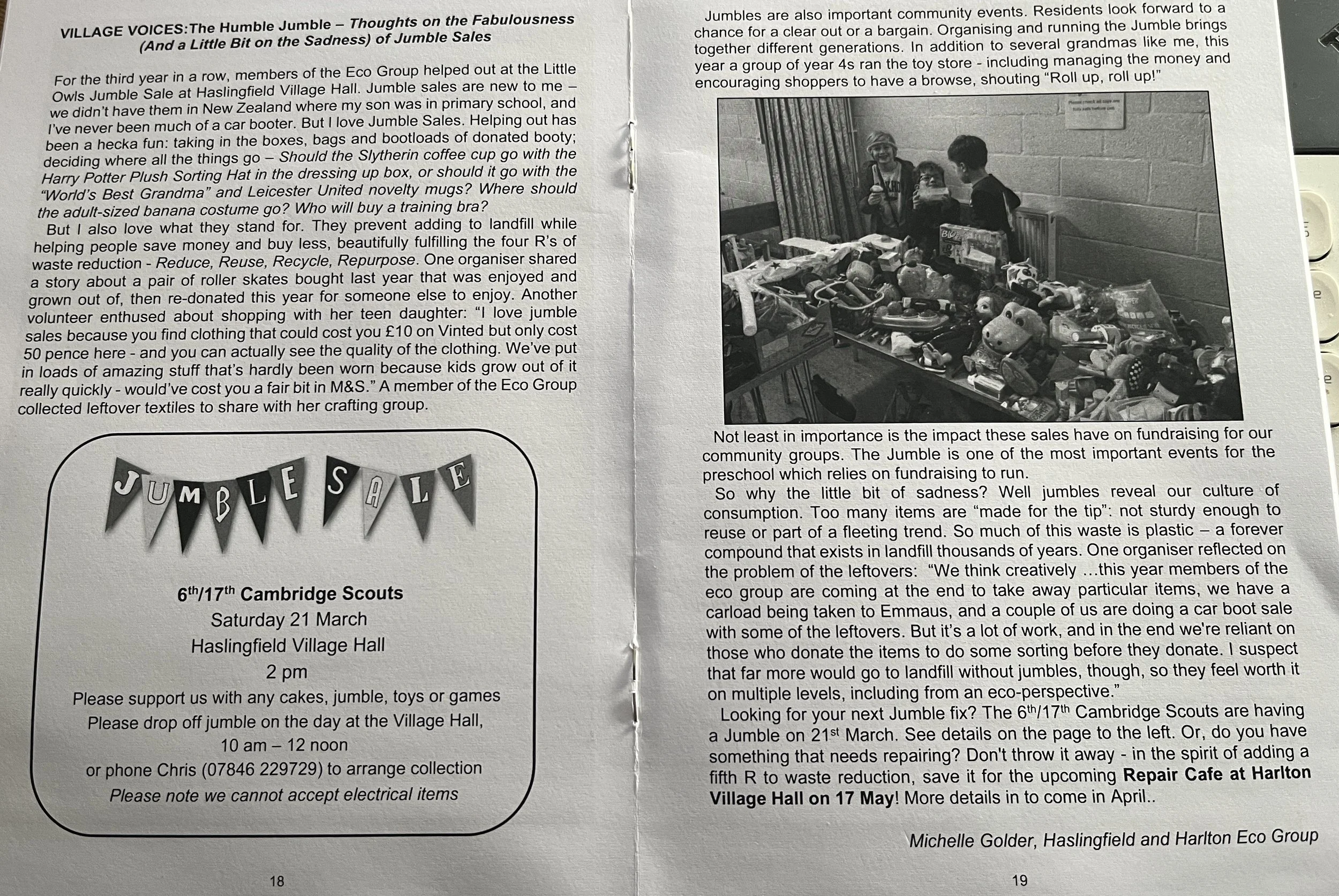
Our Jumble Sales Article in Church and Village

We were delighted to collaborate with Little Owls in writing this article for our village magazine, March 2026 issue. Editor Melissa Fu made it even better with her excellent and careful edits.

We were delighted to collaborate with Little Owls in writing this article for our village magazine, March 2026 issue. Editor Melissa Fu made it even better with her excellent and careful edits.

Read More
Behaviour Change Guest User Behaviour Change Guest User

Taking a fresh look at Christmas

There are good reasons for all of us to think actively and freshly about how we “do Christmas”.
by Sheena Mooney, Co-chair

This article was first published in the

November 2025 issue of Church and Village

Christmas can be a wonderful time, with most of us able to relax and enjoy ourselves with family and friends – at least once all the preparations have been made! The Haslingfield Christmas tree and the Harlton Triangle tree, the efforts many people make with lights and wreaths on their homes, the carol singing, concerts and of course the panto are always lovely. Not everyone can enjoy Christmas in this way, of course. I worked for many years in a homeless women’s project where some women felt the loss of connection to their family most keenly at this time of year. An increasing number of people are struggling financially and, for them, the huge pressure to consume must weigh heavily. For those who have not been raised in a Christian tradition, the hype around Christmas, which seems to start earlier in our shops every year, can be particularly bewildering.

Even if we are not affected by these issues, though, there are good reasons for all of us to think actively and freshly about how we “do Christmas”, to revisit the traditions we have developed with our family and friends and consider whether they still make sense. Not least of these is our need to care for our environment and avoid wasting precious resources. The figures on the excess waste we produce at Christmastime are mind-boggling, in terms of food, packaging and gifts that are too often unwanted, unused, and destined for the tip.

Of course, making changes is not always easy and there can be a comfort in doing things the way we always have. I was trepidatious about suggesting a limit to the number of gifts exchanged in our large family some years ago. I was surprised to find little resistance, though, and the idea was generally welcomed. Since then, in my extended family we have tried different things at different times. Sometimes we set a price limit, others a challenge to only buy second hand, and sometimes we only buy for children. What has worked particularly well for the adults in my immediate family is doing a Secret Santa, so each person just gets one gift, but it is a quality gift which has been really thought about.

We recently asked members of the eco group to share tips about different ways to make Christmas celebrations more environmentally friendly. They had masses of great ideas which we hope to share in December’s Church and Village magazine. In the meantime, as we all go into the Christmas season, let’s not be afraid to break the mould and try a new approach.


Read More
Nature Michelle Golder Nature Michelle Golder

Nature Friendly Farming in Shepreth!

Two gorgeous fields in Shepreth are benefiting nature.

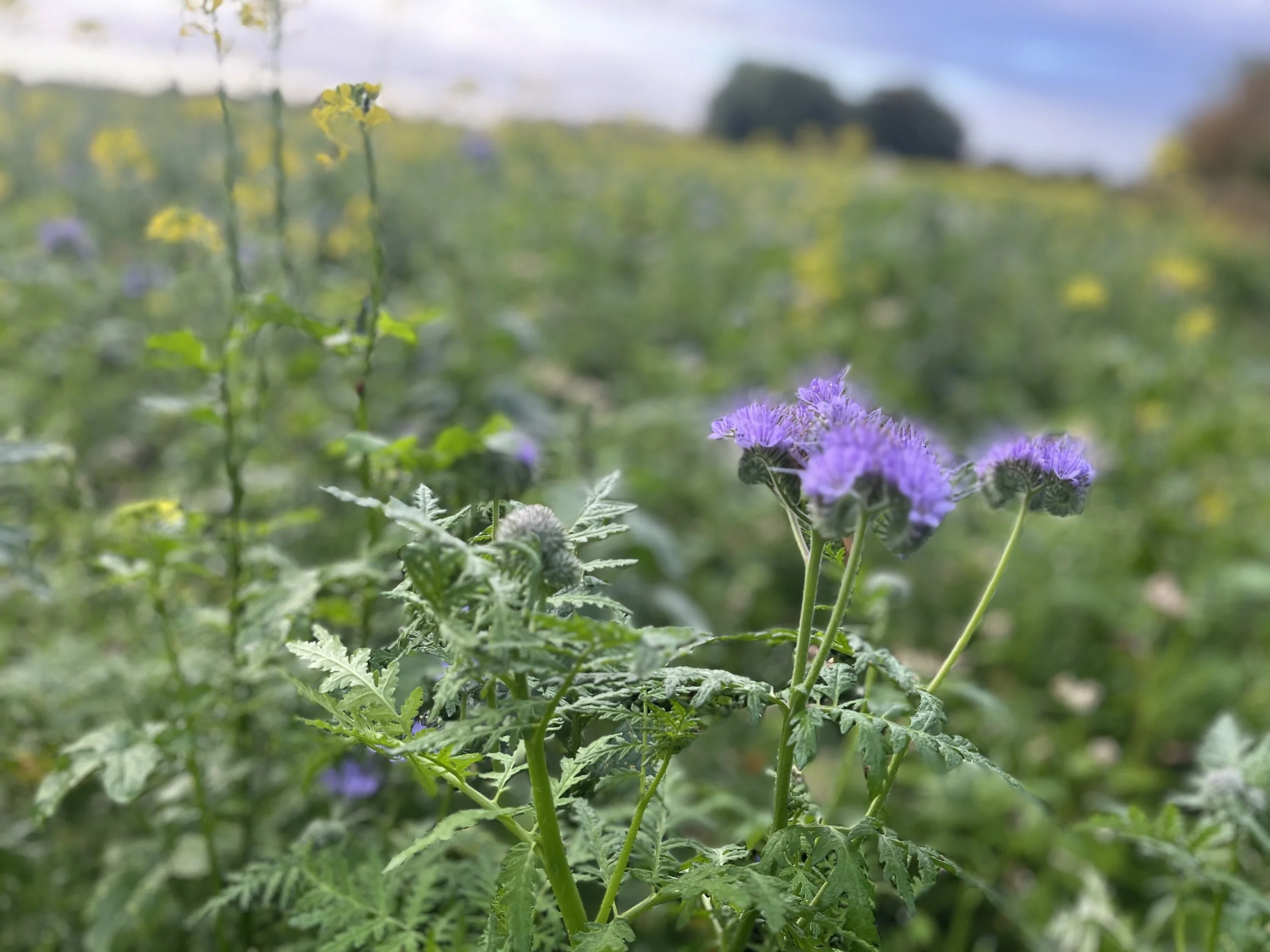
It’s a beautiful autumn, but unfortunately most of the arable fields around Haslingfield and Harlton are currently deserts for wildlife. However, a recent walk near the L-Moor in Shepreth revealed these two gorgeous looking fields which were sown with phacelia (the purple ones), sunflowers, white and yellow flowering mustard, and amaranth or goosefoot (still green in one field, but yellow orange and full of seed in the second). Both phacelia and mustard are what’s known as “green manures” - plants which lift nitrogen and return it to the soil when re-incorporated into the field. They also grow quickly and suppress weeds. Phacelia, like its relative, comfrey, is a magnet for bees and other insects too. Amaranth and sunflowers provide bounties of seeds for wildlife. The two fields look very different right now - I don’t know why that is as it seems like a similar seed mix was planted - must be to do with the soil? Answers welcome!

Read More
climate change Michelle Golder climate change Michelle Golder

Collapse, The Walking Dead and Trump’s Big Beautiful Bill – Is there a way to not be scared?

There are 533 thousand members of the subreddit r/collapse, enough to make it the subject of a recent Guardian story. Moderated by a “mixture of neuroscientists, environmental scientists, chemical engineers, government auditors and history teachers,” most of the members are people like me – ordinary folks who, for whatever reason, follow the story of what people are now calling the “polycrisis” – the coming together over the past few decades of climate change, AI acceleration, pandemic risk, rising inequality, ecological breakdown, political incompetence and…need I go on?

It's scary and depressing stuff. Following the passage of Trump’s “Great Big Beautiful Bill,” which slashes clean-energy tax incentives and boosts fossil-fuel subsidies (while cutting Medicaid and food assistance programmes for millions of Americans), some scientists have begun to declare “game over.” Canadian scientist and broadcaster David Suzuki (Canada’s David Attenborough), for example, had this to say this week:

“I’ve never said this before to the media, but it’s too late. I say that because I go by science and Johan Rockström, the Swedish scientist who heads the Potsdam Institute, has defined nine planetary boundaries. These are constraints on how we live. As long as humans, like any other animal, live within those nine constraints, we can do it forever, and that includes the amount of carbon in the atmosphere, the pH of the oceans, the amount of available fresh water, the nitrogen cycle, etc. There are nine planetary boundaries and we’ve only dealt with one of them — the ozone layer — and we think we’ve saved ourselves from that threat. But we passed the seventh boundary this year, and we’re in the extreme danger zone. Rockström says we have five years to get out of the danger zone.…And, if you look at those boundaries, like the amount of carbon in the atmosphere, we’ve had 28 COP meetings on climate change and we haven’t been able to cap emissions. We’re on our way to more than a three-degree temperature rise…”

iPolitics, 2 July 2025

Lately, I’ve been binging on the American zombie apocalypse TV show, The Walking Dead. Debuting in 2010, and lasting 11 seasons under its original title, the show, set primarily in rural Georgia (the US state), follows a group of survivors negotiating a world in which civilisation has completely broken down. No one is in charge, no supply lines exist, food and fuel must be scavenged from zombie infested houses and shops. The show, in its dramatic way, raises questions which prey on my mind a lot, both as they address the lived experience of people now and the experiences I fear for us all in the future: How – and why – do people find the strength to carry on in the face of loss, scarcity, sadness and uncertainty? Is it possible to still live with joy and love? What is the job of those who take on leadership roles? Reassurance… or Honesty? Innovation… or Sticking to the road?  Control… or Cooperation?

Unlike some other apocalyptic fictions, such as the harrowing book and film The Road, which focus on an individual’s journey through disaster, Walking Dead is very much about communities and the different ways people respond together - it’s this that keeps me gripped. The central “family” – led by British actor Andrew Lincoln, with a passable Southern accent – meets groups which have descended into cannibalism, groups led by sadistic psychopaths out for their own gain, groups living out bizarre fantasies of communion with the undead. But it also meets a resilient eco community, a feudalistic agricultural community on a historic plantation, and a group led by a benevolent “king” with his own tame tiger. Survival is the first priority of almost everyone they meet, but overarching that - for the central characters at any rate - is the quest to maintain their humanity. There has to be something to survive for, they say over and over again.

The Walking Dead is a traumatic and violent watch which I don’t recommend to everyone. It’s not scientific and it simplifies issues in a way that will turn some off. It says unpalatable things about human nature. Many times I’ve felt profoundly sad after watching it. But it’s a fiction, so I find it a less agonising watch then, say, the news from Gaza or Sudan, Antarctica or the Amazon. And in some ways, I find it uplifting. When the group, even briefly, finds what it is looking for – safety, food, time with loved ones, peace, the beauty of nature – it feels so good. It reminds me that those things are all I need for happiness.

The collapse today’s “doomers” envisage is unlikely to be as sudden as the catastrophe that afflicts The Walking Dead’s characters. Most people talk about an increasing “enshittification” of life, likely to proceed unevenly across nations, geographies, and socio-economic groups over decades. Some degree of it, I agree with Suzuki, is no longer preventable – in fact we are in it already. To prevent it becoming eventually apocalyptic – which 3 degrees of warming would be - we would have to stop emitting CO2 and stop destroying the natural carbon sinks (healthy soils, oceans and forests) which reabsorb carbon dioxide, and start radically repairing them, now, today, everywhere. There are many people trying to do this. Many more are needed. Whether we can succeed remains to be seen.

In the meantime, I find inspiration and energy in thinking about alternatives to enshittification. I remember the positivity at the Cambridge Carbon Footprint AGM last month - their Repair Cafés, Open Eco Homes and Imaginarium projects are blowing up around the region (they need more volunteers).  I remember the excitement of the young engineer explaining Grantchester’s proposed Heat Network project to me at their recent open day (it could supply every home in Grantchester with zero carbon, zero maintenance heat based on shared heat pump/solar and wind energy).  I walk around our village and our city and see the many spaces embracing a “Let it Grow” ethos – and the many more butterflies, beetles and bees thriving as a result. And I find hope in knowing that the future is still there to be written, by us, by what we choose to do. In the words of one of my favourite authors, Ursula K. LeGuin:

“Hard times are coming, when we’ll be wanting the voices of writers who can see alternatives to how we live now, can see through our fear-stricken society and its obsessive technologies to other ways of being, and even imagine real grounds for hope. We’ll need writers who can remember freedom — poets, visionaries — realists of a larger reality.”

Acceptance speech for

The National Book Foundation Medal for

Distinguished Contribution to American Letters, 2014

Wellhouse meadow bonfire area, June 2025

Read More
Michelle Golder Michelle Golder

From the Cell to the Planet, a first hand report from international conference

by Dr Roli Roberts, Harlton Resident and Senior Editor, PLOS Biology

Can cell and molecular biology play a significant role in achieving planetary sustainability? This was the issue of the moment at the “Integrating Cell and Planetary Scales to Address Climate Resilience” conference at the Gulbenkian Museum, in Lisbon, which I had the opportunity to attend this April.

This conference, sponsored by the European Molecular Biology Organisation (EMBO), was framed as a way of galvanising cell and molecular biologists – people who tend to think about very small things – to think about how they might tackle the very large problems that currently face humanity.

As well as about 100 active research scientists from around the world, the meeting was attended by the Chief Scientist of the World Health Organisation, the Director of Climate & Health for the Wellcome Trust, representatives of several other major research funders (UKRI, European Commission, Pasteur Network, Max Planck Society, EMBO, Novo Nordisk, Gates Foundation, Moore Foundation), editors of four international journals (including me), and the Portuguese minister for energy and the environment.

 Many of the scientific talks focused on using genetic modification of plants and microbes (bacteria and fungi) to reduce emissions, produce foods and other materials more sustainably, enhance carbon capture and tackle pollution. One interesting suggestion involved the use of bacteria that can consume CO2 instead of sugar to generate sustainable food from power station flue gases, thereby killing two birds with one stone (sustainable production and carbon capture). Here’s a list of my highlights:

·       Improved crops that can be grown on poorer soils

·       Cyanobacteria engineered to make hydrogen

·       Bioplastics that reduce dependency on fossil fuels (and increase biodegradability)

·       “Bionic leaves” that combine photovoltaics with CO2-consuming microbes

·       Biomonitoring systems for water contamination

·       An artisanal chocolatier making chocolate from bacterial fat!

 Most of the ingenious ideas cooked up by scientists, however, are likely to hit problems when implemented in the real world. These usually stem from issues of scalability and economic constraints. For example, microbial foods are only economically feasible for high-price items (e.g. meat replacement, rather than staple foods), as they can’t be made for less than $1-2 per kg. And these would need to have appealing flavours and textures to gain any market traction, which may prove challenging…

 To give you some idea of the tone of the conference, here are a few quotes that particularly struck me (to the extent that I posted them on Bluesky!):

·       “80% of the nitrogen in your body has been through the Haber-Bosch process by which industrial fertiliser is made.”

·       “The way in which our universities have divided up our sciences does not reflect the way in which nature has divided up its problems.”

·       “We have a cultural problem – green parties don’t like GMOs or animal work, even though we share aims. Also [Trump] is portraying green aims as anti-progress and holding us back. We need to make sure that green is seen as progressive.”

·       “Focus on the fierce urgency of now; the choice between curiosity-driven science and future aims is a false dichotomy.”

·       “Do not flinch from watching the news; science is a source of optimism and hope in the future.”

·       “I see a future in which nature gives us a helping hand. Instead of destroying the natural world, why can’t we use it to solve the kinds of problems that we are facing.”

 I should say that the elephant in the room was the worsening situation for American scientists, whose work on these very pressing issues is being discouraged and defunded at the time when they’re most needed. As one speaker put it, “The loss of US federal employees from both national and international organisations is an acute loss of global expertise at a time when we can least afford it. At a point when we need global solutions to global problems, some nations are seeing the answer to lie instead in nationalism.”

 Despite this gloomy background, my feeling was that most attendees went away with a sense of renewed purpose, and a resolve to meet again in a few years’ time with more focused aims. They’ll also work on a white paper to crystallise some of the bigger picture ideas that emerged from the panel discussions and round-table sessions.

Read More
Michelle Golder Michelle Golder

Carrion Comfort and Real Relief

Yesterday, I attended one of the most honest and, hopefully, galvanising events on the environmental crisis that I’ve ever been to – and I’ve been to quite a few. Two big guns of UK climate messaging, Tony Juniper, CBE, and Mike Berners-Lee, were together to talk about their new books, Just Earth and A Climate of Truth, respectively, and I kind of hope things will never be the same.[1]

In personality they seemed very different: Juniper measured and deliberate, Berners-Lee passionate, evangelical, sitting forward in his chair and searching out the eyes of members of the audience. But as Berners-Lee pointed out in his introduction, both their books had reached the same conclusion: the metacrisis - a crisis of everything, everywhere, all at once - is upon us, it is an existential threat to humanity, and the window in which solutions are possible is closing fast.

That wasn’t news to me. But it’s not a message I hear in public, in our political discourse or mainstream media. I hear it in podcasts like Breaking Down: Collapse, Planet Critical, Sarah Wilson’s Wild or Nate Hagens’ The Great Simplification. I read about it in the r/collapse subreddit (527k members).  And it’s been Extinction Rebellion’s message from the start. But to see two members of what I would call the mainstream, sitting in front of an audience of 200 in the Cambridge Union as part of the Cambridge Literary Festival, and to hear the truth being spoken out loud…it felt new. It felt important.

Berners-Lee laid out the elements of the crisis: the mass extinction of species which is happening faster and affecting more living things than at any time in the earth’s history since a meteor wiped out the dinosaurs 85 million years ago; uncontrolled pollution, particularly of plastics, which are now found everywhere on earth, including Antarctica and inside human brains, with as yet unknown effects; soil depletion reducing crop yields; water conflicts, such as the one brewing on the Indian/Pakistani border; ocean acidification; threats to democracy; and so on and so forth, across nearly every system, human, physical and ecological. Then he asked the audience a question – did they think he had overegged the problem? The unanimous answer was no. The audience understood the gravity of the situation.

How, then, as George Monbiot put it in the title to one of his books, did we get into this mess? And how do we get out again? Berners-Lee’s book focuses on honesty. Politicians, advertisers, corporate boards and the media need to start facing – and telling - the truth. That we can’t keep consuming resources and growing – as defined, at any rate, by economic growth metrics - on a finite planet. That we’ll be just fine without single use plastics. That the fossil fuel industry has manipulated the COP process from the beginning (go see the play Kyoto at Sohoplace for a bitter but surprisingly entertaining rundown of that history).

Juniper, on the other hand, emphasises justice. That it’s not fair to expect developing nations to bear the same decarbonisation burden as the developed world, which has been emitting greenhouse gases for 200 years, and which still, on a per capita basis, has an enormous carbon footprint. Nor is it fair to act like everyone in the developed world bears an equal responsibility. Oxfam’s Senior Climate Justice Policy Advisor, Chiara Liguori, pointed out in 2023 that: “It would take about 1,500 years for someone in the bottom 99 per cent to produce as much carbon as the richest billionaires do in a year.”[2]

I have to confess, at this point in the conversation I was feeling a bit angry. It all felt a bit top-down. How can I stop the fossil fuel industry from influencing governments, or the media from publishing what sells instead of what people need to hear? How can I influence the government of the USA or Brazil or China? How can I stop Bezos and Musk from pursuing their toxic agendas of sending pop stars to space or colonies to Mars?

But these two wrapped it up rather well. First of all, Berners-Lee said, we need to understand that we do have solutions for all these problems. It will be hard. It’s not impossible. We have to start growing better things instead of just the most profitable. Things like Wellbeing. Renewable energy. Equality. Biodiversity. Clean Air. Childcare provision. Healthy food. Safe streets.

Juniper pointed out that the most important thing we as individuals can do is pay attention and talk about the crisis. Acknowledge it. Face it. At work, at home, in your community. Do the little bits you can. Refuse consumption you don’t need. Vote for politicians who tell the truth as a first order of business. Stand up for a just transition. Reconnect with nature and discover our place in it and of it.  Protest, volunteer, share, repair. Prepare your kids for a less luxurious but much more purposeful life. Feel the fear and do it anyway. Be determined.

The only wrong thing we can do right now is nothing. The poet Gerard Manley Hopkins sums up how I, for one, feel right now:

“Not, I'll not, carrion comfort, Despair, not feast on thee;

Not untwist -slack they may be - these last strands of man

In me or, most weary, cry I can no more. I can;

Can something, hope, wish day come, not choose not to be.”

 Please share your thoughts below.

Michelle Golder, April 2025


[1] In case you’re unfamiliar, Tony Juniper is the current chair of Natural England, has worked with or for many of the  most important global and national conservation organisations, including Friends of the Earth, Birdlife, The Wildlife Trust, and Fauna and Flora International, is a Fellow with the University of Cambridge Institute for Sustainability Leadership (CISL), and is the author  of many books. Mike Berners-Lee is probably best known as the author of the influential books How Bad are Bananas? and There Is No Planet B and is a Professor at Lancaster University. He’s also the brother of Tim Berners-Lee, who invented the internet.

 [2] https://www.oxfam.org.uk/media/press-releases/richest-1-emit-as-much-planet-heating-pollution-as-two-thirds-of-humanity-oxfam/

Read More
events Michelle Golder events Michelle Golder

Report on the 2025 AGM

Our 2025 AGM took place on April 2nd. Click to read about it.

Twelve people gathered in Wisbey’s Yard Community Room for Haslingfield and Harlton Eco Group’s 2025 AGM on 2 April. It was a relaxed occasion with time to connect, reflect on what the group has been doing, gain inspiration and share ideas about our future direction.

We all introduced ourselves and welcomed our two visitors from other local groups, Sustainable Shepreth and Friends of the River Shep. Chair Michelle then introduced this year’s Annual Report and there was time to read it and ask questions. Click here to read the report.

Interim Treasurer Lisa said a few words about the finance report she had prepared, which was followed by a brief discussion.

We appreciated the work of Lucy and Alison who have stood down as Treasurer and Secretary. Lisa now officially takes over as Treasurer and Michelle and Sheena will act as co-chair and Secretary. Caroline joined the committee, and Lara will seek a representative from Friends of the Rhee to join too.  Committee members who are continuing this year are Anne, Pippa and Alison.

Next we showed two short films:

“The Story of Solutions”, which explores how we can move our economy in a more sustainable and just direction. (https://www.storyofstuff.org/movies/the-story-of-solutions/)          9 minutes

“From What Is to What If, a Walk through a Day in 2030”, by Rob Hopkins, founder of the Transition movement.  (https://www.youtube.com/watch?v=aTNhpXdyciM)         2 minutes

This led into small group discussions where we shared feelings and ideas generated by the films, as well as our thoughts about where our group focus should be now. Back together we heard from each group and closed with a round where each of us identified our personal next steps.

The new steering committee will begin meeting soon, with an agenda of revising our constitution and meeting schedules, as well as deciding on our next steps in the coming year.

Sheena Mooney


Read More
Michelle Golder Michelle Golder

We’re on the road to…Where?

The evidence is pretty clear. When people have to, they are very good at organising themselves out of trouble. Problem solving is our superpower, and since our systems are preventing us from exercising that as a joined-up population, we need to exercise it in smaller groups - at the street, neighbourhood, parish, county, town or city level. But we can’t do that while we’re on the motorway, pedal to the metal, and all our energy focused on keeping that bus on the move. Some energy needs to go into inventing a future that avoids the road and cliff at the end of it.

Join the Haslingfield and Harlton Eco Group at our AGM April 2nd, 8 pm at Wisbey’s Yard Community Room to be part of the conversation.

It’s been a bruising 3 months for me. I have family still living in the US, people now at risk from job and funding cuts, not to mention cruel and inhumane executive orders. I’m scared for the fate of Europe if Trump continues to appease Putin or enacts his punitive tariffs. The climate and environmental news continues to be mostly discouraging. On my bad days I have a sort of grim daydream playing in my head, which goes like this:

I’m stuck on a congested motorway. All of us on this motorway know – the signs keep telling us – that it leads, somewhere ahead, to a bottomless cliff. We’ve also noticed that the slip roads are becoming fewer and farther apart and the tarmac cracked and potholed. We’re seeing piles of rubbish everywhere. Part of us thinks it’s time to get off.

The car radio is full of conflicting advice, though. Some voices do say, “Get off, as quick as you can!” and tell sad stories of people who have already fallen over the cliff. But others joke about the “cliff hoax,” or distract us with entertainment. Even more confusingly, some voices admit that the cliff exists but tell us we’re still best off staying on the road. “I’m not a cliff-denier,” they say, “but better to stay with the route you know.”

Our guts, when we let ourselves listen, tell us that doesn’t make sense, and this isn’t a hoax. But when we look around, everyone else’s eyes are on the road. We feel like if we could just connect with everyone, we could make sense of all this and could just stop. Back up. Turn around somehow.

But we’re not 100% sure. And the traffic keeps moving. And so we keep going. Faster and faster. Darker and darker.

When I look around my actual community, I see smart, clued-up, kind-hearted and responsible people. And it occurs to me that, so responsible are they, they might be compared to bus drivers on this lost highway. They have a job to do, and it’s to get this busload of people – their family, their community, their place of work - safely down the road. As we’ve already seen, the road is tricky. The information near useless. The pressure high and the options few. And all those people on the bus – maybe their children, grandchildren, aging parents, teammates, friends, lovers – are counting on them. It takes everything they have to keep the bus going safely and the folks calm and happy.

But we’re all still heading straight for the cliff.

This scenario really resonates with me. Like so many others, I feel in my bones that our society, if not all of human civilisation, is on a road to disaster – whether via climate change, spreading autocracy, war and other violence, pandemics, economic breakdown, or all of the above combined into what many are calling the metacrisis.

But it is, of course, not the full picture. We are not stuck on motorways. We exist within real communities, and communities, from the dawn of human existence, have worked together to solve problems.

Once we remember that we belong to communities, and can talk to each other, we can organise.

Once we come together, we can start to decide on the next steps which will lead to resilience and hope.

Will that make the cliff go away? No, not for a while anyway. Will it stop those who continue down the road from pushing themselves and others over it? Maybe, if enough people take part.

Will it even “save” us and our busloads of loved ones?

The evidence is pretty clear. When people have to, they are very good at organising themselves out of trouble. Problem solving is our superpower, and since our systems are preventing us from exercising that as a joined-up population, we need to exercise it in smaller groups - at the street, neighbourhood, parish, county, town or city level. But we can’t do that while we’re on the motorway, pedal to the metal, and all our energy focused on keeping that bus on the move. Some energy needs to go into inventing a future that avoids the road and cliff at the end of it.

The journey of learning I’ve been on, since 2015 when I read Naomi Klein’s book, This Changes Everything, has shown me that there are great ideas out there for how to get onto a new and better path. We don’t know which will work. But I for one am ready to start trying.

At the AGM, after a very brief bit of committee business and some inspirational input, we’ll be brainstorming ideas for projects/talks/activities to help our community become more resilient. Where there’s energy behind these ideas, we will make them happen. Do join us!

Michelle Golder

Chair


Read More
Michelle Golder Michelle Golder

What is Community Energy?

This article was written for the Haslingfield Parish Council quarterly newsletter, Spring 2025

At a recent East West Rail public meeting organised by Haslingfield Parish Councillors, funding for a local solar farm came up as a possible offsetting “ask”. This sparked some comments and questions, such as, how can that benefit the whole community? Haslingfield and Harlton Eco Group has been looking into the idea of Community Energy, so here is a quick rundown of what that means, to help people decide if it’s something they might like to see locally.

Community Energy is any energy producing (or saving) initiative which provides benefits directly to people instead of to commercial energy companies. Most solar/wind farms currently are owned by energy companies, including fossil fuel companies. The local community may have no say in where these go or what they look like. Community energy projects can put communities in charge and send profits back into community coffers.

Some local examples of community energy include:

Gamlingay Community Turbine, operating since May 2013. Community funded from a combination of loans and investment, it cost £900,000. It generates a 6% rate of return for its investors, and as of 2023 had donated £77k to community projects.

Reach Community Solar Farm, operating since January 2016. Owned and run by a Community Benefit Society made up of local people, it generates enough electricity to power 50 houses. The farm cost £340,000, invested by 112 local people. While providing a good return to investors, it donates some of its income to a Community Benefit Fund to be spent on other local projects.

Whittlesford Memorial Hall Solar Array, operating since January 2012. A 40 panel, 10kw system, it has generated in excess of £50,000 so far for improvements to the hall and community initiatives.

Haslingfield parish can’t install wind turbines because of restrictions around the radio telescopes (these have also paused the UC solar farm planned off Barton Road). However, we could partner with another village, have a solar farm farther from the telescopes, or look at an expanded solar array over the village hall/car park/play area. We could also look at community bulk buy, for solar panels or retrofitting. Interested in helping us scope the possibilities? Write to Michelle Golder at michellegolder@gmail.com.

And some good news for our Parish: according to the Centre for Sustainable Energy’s Impact community carbon calculator, our parish emissions have fallen from 14,089 tCO2e (tons of CO2 equivalent) in 2023 to 10,304 presently. In 2023 we exceeded average South Cambs emissions in every category, but we are now slightly below average emissions for the region in every category but housing. We do still exceed the national average figures, but by less. It’s impossible to say exactly why this might be, but it’s good news nonetheless!

Read More
Michelle Golder Michelle Golder

Struggling to Make Sense of East West Rail Maths

Below is my full submission to the January 2025 East West Rail consultation. This was also emailed to our MP, Pippa Heylings. If you have comments or critiques I would love to hear them.

As a local environmental activist for 10 years now, I wanted to support this railway when it was announced. I support public transport and believe 100% in the need to get cars off the road to make room for buses, trolleys and bicycles. But the more I have looked into it, the more complicated my feelings and opinions have become. Do the reasons behind it make sense? If so, is the route the right one? Is it about getting cars off the road, or is it just about facilitating local growth?

I think I understand the arguments for the need for growth, and that without it we face at the least an economic crisis, with impacts across all but the very richest levels of society, with all the ramifications of that. Our system is based on profit, profit requires growth, without profit the whole system grinds to a halt. However, I also understand a law of physics: only a limited global emissions “budget” is left to keep warming to a level beneath catastrophic. We are caught, therefore, between two bad choices. One – stopping growth - could shake the foundations of our current civilisation, but the other – unchecked global warming - could still do that, while also destroying many or most of the earth’s ecosystems which support life. Neither choice is great, but that’s where we are at, and for me the first option – putting a hold on growth - seems better. What’s more, smart people are looking at ways of making it work.

The Danish building industry, for example, took this dilemma seriously. Working in partnership with advisors, research institutes, architects, and NGOs, it launched a project – the Reduction Roadmap - to translate the Paris Agreement and the Planetary Boundary for Climate Change into industry-specific reduction targets for new Danish housing projects.

The project reached a shocking conclusion though. To stay within its share of the planetary budget, the Roadmap concluded, the Danish building industry needed to reduce its emissions by 95%. In effect, construction, as it had been done, was off the table. New materials needed to be developed, the supply chain circularised, construction transport needed to be decarbonised, and a different approach to the built environment needed to be taken – one based on reuse and remodel, rather than new build.

This, to me, seems the most rational lens through which to view all kinds of material economic development going forward. What can we afford to spend, emissions wise, and how can we keep within that budget? And how does this apply to East West Rail? Below are some of the questions I still don’t feel have been satisfactorily answered for me to support this project.

Question 1: How does East West Rail enable the UK to stay within its emissions budget?

The campaigning group Cambridge Approaches made a very impressive attempt to analyse the CO2 impacts of EW Rail from the information provided in its materials and comparisons to HS2. I acknowledge that this analysis is not perfect. I ran it past a transport expert who pointed out some flaws - but nevertheless agreed that (quoting under Chatham House Rules): “It may… be the case that the construction carbon emissions are higher than the saved carbon emissions over 60 years. That could lead one to conclude, perfectly rationally, that the railway shouldn't be built. However, the assumptions that lead to that conclusion are based on business-as-usual in travel patterns. Plenty of research has shown that this is not compatible with a 1.5C carbon budget (which we are on track to exhaust by 2030).”

Which leads me to my second question -

Question 2: How will EW Rail achieve and maintain modal shift and is this being communicated effectively?

As the expert’s comments above show, much of the hopes for the sustainability of EW Rail ride on it helping to achieve modal shift – getting people who are currently driving cars onto public transport, whether for work or leisure. But absent a congestion charge or road toll, it’s not clear to me how this will be assured, especially given the projected population growth. If not achieved, EW Rail will have become a gigantic boondoggle in terms of emissions reductions.

From a purely local perspective, for those of us who live along the route between Cambourne and Cambridge – those most affected by the construction and route - the train offers nothing to help us with local travel, and people are therefore struggling to see the environmental benefit – a huge challenge to people like me who are trying to make the sustainability case. We don’t gain a closer station. Worse, the diversions which railway construction will cause, as it passes over or under connecting roads between villages, may force people who currently cycle or walk back into their cars for months or years or even for good if the connectivity is not as good or better after construction.

We also struggle to understand why the EW Rail materials cite traffic reduction as one of the perks for South Cambs. Are large numbers of biomedical campus commuters from Cambourne or Bedford using southern routes like the A603 or the A1- A10 to get there? These are the routes which affect residents of Comberton, Haslingfield, Harlton, Newton, Harston, etc. I understand that EW Rail is part of a new, joined up travel plan for our region, which includes potentially expanding Foxton station and a new Park and Ride at Harston, and hopefully Cambridge South station will on its own improve the traffic situation for this side of the county. But why hasn’t this vision, if realistic, been communicated better? Why doesn’t the communication take its most likely audience (those most affected) into account? Saying EW Rail alone will reduce traffic for us feels like a falsehood.

Finally, modal shift will be hugely dependent on pricing. Whether for leisure or commuting, while it is less expensive to drive people will continue to do so, and many better off people will do so at any price. How has the failure of the congestion charge affected the projections for EW Rail? How much will the train tickets cost?

Question 3: Where is the Reduction Roadmap for construction in the UK?

As of 2023, emissions have continued to rise and the 1.5-degree budget has therefore been halved. What’s more, we have already reached 1.5 degrees of warming in each of the past two years and are projected to do so again in 2025, so the target itself has been raised to 1.6 degrees. Our current emissions trajectory, if we don’t make huge cuts, will lead to something more like 3 degrees of warming – a level that will be inconceivably bad. So we need to know how these major infrastructure projects fit into the UK’s emissions budget.

One of the expert’s criticisms of the Cambridge Approaches analysis was its inclusion of emissions from the construction of the additional housing associated with, and to some extent dependent upon, EW Rail - 100-150 thousand new “dwellings” are suggested by the Cambridge 2050 project, though not all of these would be on the train route. These needed to be considered separately, they argued, because if not built here, they might be built elsewhere. Whether that is true or not, excluding them from the emissions picture seems out of step with logic– every national sector needs to understand its contribution to the emissions budget, and how the sectors interact with each other. If EW Rail is actually a conduit for growth, then we need to know if the growth itself fits rationally into such a budget.

Question 4: How will a route choice which prioritises economic interests over environmental protection help to win people over to the changes needed?

The decision to take the Southern over the Northern route for the railway was not based on cost (the Northern being slightly cheaper) or environmental impact (the Northern being slightly less destructive), but on “value”, which Head of Communications Hannah Staunton defined as job opportunities within 15 minutes of Cambridge South Station, or, to quote the 2023 Route Update report, “[the Northern Route] would make it harder for people living in Bedford, the Marston Vale or near St Neots/Tempsford to access the jobs at the Biomedical Campus – and therefore it wouldn’t deliver the economic opportunity that underpins the case for EWR.”

This is hard for the communities affected by the railway to swallow. There is anger and resentment – and this comes from both sides. Those upset about the route are called selfish, privileged, NIMBYs; those supporting it, including EW Rail staff and local politicians and officials, are called greedy and rapacious or cold-hearted and insensitive. None of it is helpful, and all leads to increased difficulty in making progress on any of the many environmental fronts which need to be addressed. A recent blog post from Cambridge Sustainable Travel Alliance really triggered my anger, with a single line: “While it is certainly true that any new infrastructure project will impact its surroundings” to address the major transformation the railway, in its construction and operation, will make to my own and surrounding communities. And that without conferring any direct benefits other than the promised “less traffic”. This is not enough. Local people need acknowledgement that we are being asked to make a very large sacrifice for the good of everyone – and we need reasons to believe that that good is genuine and important. Without a more intelligent and joined up approach to communicating with the public – one that faces facts, no matter how unpalatable, we risk going down the route so many of our international allies are on – to increased divisions, mistrust of democratic processes, and an epidemic of hopelessness and apathy.

Question 5: What is the train good for?

I completely understand that growth, including growth of the biomedical campus, absent the train and/or other infrastructure, spells disaster on all fronts: economic, congestion and emissions. If the growth is inevitable, the train might be as well, even if a rational analysis like the Danish study was carried out and showed the maths didn’t add up to sustainability.

When I interviewed Cllr. Bridget Smith about the OxCam Arc three years ago she argued that growth was the only way to get the funding needed for environmental improvements. At a recent Community Climate Action conference she doubled down on this, saying she was pushing for 20% net gain from the railway – still a tiny amount in our region, as one of the most nature-depleted in the UK. So this is what I hope for from the development:

• Improved connectivity between villages and infrastructure, including schools and surgeries, via cycling and walking tracks beside the railway.

• 20% biodiversity net gain, targeted at local areas. Most of the Cambourne – Cambridge route is rural, so liaison with local farmers, parish councils, landowners and nature groups to identify marginal land which could be improved, to directly benefit communities along the route.

• Educational materials and programmes to help the public understand the need to decarbonise and how the railway is addressing the issues I’ve raised above.

• Investment in local public transport, perhaps a fund supported by biomedical campus companies who stand to benefit the most.

• An ombudsman to ensure that promised improvements are carried out.

• A maintenance plan for any environmental improvements running alongside or adjacent to the railways (i.e. balancing ponds, hedges) to maintain health, aesthetics and quality of habitat.

• An approach to the environment which puts it first. Which, for example, recognises that natural spaces are not of value just when they have been registered and quantified as such, but puts caring feet on the ground to look for special places in the landscape. Haslingfield’s Quarry, or Clunch pit, for example, is a County Wildlife Site, a rare chalk grassland rich in wildflowers, on private land, but not an SSSI, for reasons I don’t understand but may be because the landowner objected or it was feared they would object. One of only two places in the three counties of Northamptonshire, Bedfordshire and Cambridgeshire which is home to rare Man Orchids, the railway will pass within a few hundred metres of the site. From the top of the adjacent ridgeline, visitors can see an exceptional and unique 360 degree panaroma North to the city of Cambridge and South to beyond the A10. It’s a stunning view at all seasons, but it's invisible on maps or satellite views which makes all the land look flat. This (southern) view will be bisected by the railway. A place where many villagers walk every day will be disfigured and noisy, and I can’t see any way of screening that, unless the tunnel will be completely invisible.

• An approach to communication which recognises the importance of place to people’s mental health and to the cohesiveness of our society. Which takes people’s concerns seriously and gives honest answers. For example, recognition that South Cambs villages are being asked to make an enormous sacrifice of their place, and their peace of mind, for a greater good, and clear explanation of what exactly that greater good is, rather than attempts to convince people of local benefits that are wishful thinking at best.

• Train travel that is significantly cheaper than driving or flying – or even comparable in price, though this alone will not achieve modal shift in my view.

• A plan for how greater Cambridgeshire will access this train. There’s no parking on the biomedical campus, and I know Cambourne will not want to support massive car parks. Will there be bus services from villages to Cambridge South?

Michelle Golder

Chair, HnH Eco Group

Read More
Parish Council Reports Michelle Golder Parish Council Reports Michelle Golder

Report for Haslingfield Parish Council - December 2024

Every month, a member of the Haslingfield and Harlton Eco Group attends the Haslingfield Parish Council meeting. Where we have had activities, or wish to make requests, we submit a report in advance of the meeting and are given the opportunity to speak to our report as an agenda item. Below is the report given for the meeting of 9 December, 2024. Since this report was delivered, Pippa and Michelle met with a representative from SCDC who undertook to contact environmental services about dredging the pond and possibly cutting back the tops of the trees.

I. Biodiversity project updates

Swift Box: We now have two villagers looking at whether they can make the swift box for us using the plans provided by Action for Swifts. Action for Swifts said that as long as the box is in place by May 1st we will be in time for swift migration. If one of the residents agrees to make it, the eco group can cover the materials cost.

Wisbey’s Yard pond waterway: Michelle had a phone conversation with Rob Mungovan, former ecology officer for SCDC. During his tenure he carried out several projects in Haslingfield and knows the area well (he is currently Ecological adviser to the Friends of the Shep group which has successfully restored parts of that chalk stream). He was one of a group of people who planted wildflowers in the part of the meadow the eco group currently looks after, many of which are still surviving. With Mr Rutherford and Martin Heazell, he maintained the Wisbey's Yard pond with twice yearly desilting and cutting back of the surrounding trees.

We discussed our idea about partnering with SCDC to look after the whole watercourse from Wisbey's Yard to the Millenium Pond. The key points:

• He agreed that the Millenium Pond will chronically silt up as it is in the watercourse with restricted outflow. He suggested that the outflow on the other side (currently quite choked by the remains of the fallen poplar) could be lowered to increase flow, but this may be very difficult to achieve. He thought the idea of another pond beside the watercourse but separate from it was an excellent one. His only caveat was that it might be overshaded by the large trees (alder and field maple) surrounding. We have not yet managed to get a quote for this. Once we have, a public consultation, especially if trees need to be cut, might be a next step.

• He confirmed that he had observed great crested newts in a local resident’s pond and thought he had recorded them with CPERC. However, Pippa has confirmed that there are no reports of GCN in the village. It should be a matter of priority to confirm their presence next spring and get them registered. We have been in touch with both of the residents who indicated they had GCN and both agreed to a survey in spring. This would need to be done by a registered ecologist. Pippa is looking into whether her colleague can do this for us.

• He supported strongly the idea of "chasing" SCDC to get them to maintain the Wisbey's Yard pond, including potentially removing or trimming the surrounding trees which are badly shading the pond, and repairing or replacing the wooden viewing platforms (which are unsafe). He did not think we should use our funding or volunteer to look after it as it is their land and they should be doing so. However, Lise has now made the initial contact with the right people at SCDC and they have indicated their willingness to work with the Eco Group, but that their resources are limited in terms of carrying out surveys and funding. We will pursue this contact and keep the PC posted.

• He thought the waterway between the two ponds was definitely worth noting and mapping as an important wildlife corridor.

• He noted that the channel on the other side of Porker's Lane from the Millenium pond, which is in the PC’s care, had been dug too steeply and could benefit from gradation to the sides. However I mentioned that it is regularly polluted with sewage so he said until that was sorted we shouldn't bother trying to improve it.

• He emphasised the importance of doing projects the community can see and benefit from.

• He said he would be happy to answer further questions but could not get involved with site visits or assist with projects for at least some considerable time.

II. Scything

Despite a rainy day, the scything workshop on 1 December was very successful. Over the course of the morning 13 people took part and many more stopped round to watch and learn. Even though most were trying scything for the first time, we managed to scythe and rake half of the area. The next event will take place on March 30th.

III. First meeting of the River Rhee Monitoring Project

Our insurers have confirmed that our public liability and volunteers insurance will cover the volunteers for this project. The first meeting for potential volunteers took place online on Dec 3rd. A keen and well informed group talked about the reasons to monitor water quality in our local river, the local support offered by the network of organisations involved in river protection, and how the project intends to prepare for and then carry out monitoring for e.coli over the next 3 - 9 months. View all the slides from the event HERE.

IV. Great Collaboration: Toolkit uptake + Session on Carbon Literacy Project

Following the article in the November PC newsletter, the number of parish residents who have responded to the Great Collaboration Toolkit increased from two to six. This is a start, but not a great start. Further encouragement using social media or reminders in future newsletters would be useful!

The latest Great Collaboration session, on December 4th, was on the Carbon Literacy Project. This project provides training on up to date climate change causes, impacts and actions to organisations including Parish Councils. To date they have trained more than 100 PC’s. This was a very inspiring talk, with examples given of Parish and Town Councils who had emphasised collective solutions, such as embedding Repair Cafes into their yearly plans and using government funding to improve numeracy skills to provide training in transition-oriented employment. It will be good to take this inspiration into drafting the new action plan for 2025.

V. Video recommendation

Streamed live on 28 Nov 2024, this 1 hour talk by the distinguished British Academy Global Professor Paul Behrens succinctly and clearly sets out where we are now in the existential battle to control climate change, busts some myths about public attitudes, mining and batteries, and gives some concrete goals that we can work toward as a community, especially, “electrify everything”.

'Towards a liveable planet: land, energy and food system transitions' with Prof Paul Behrens - YouTube

Read More
climate change, activism, politics Michelle Golder climate change, activism, politics Michelle Golder

Time to Grab Our Opportunities

“You have the biggest opportunity, in all of human history, to live an incredibly meaningful life. And the actions that you take, because of the accident of the time of your birth, are of an order of magnitude in importance compared to most people who have lived before, because you are going to affect the future of life on earth in 50, 500 and 500,000 years by what you do in the next couple of decades. So, no one is asking for an easy life, really, deep down, we’re asking for a meaningful life, and living now is an incredible gift.”

Tom Rivett-Carnac on answering the question: “Are we going to be okay?”

(Outrage and Optimism podcast, episode 211)

Sometimes someone says just the words you need to hear, and today, I needed the quote above. As I write, the Sustainable Travel Zone proposals for Cambridge, which I supported, are in grave peril. Despite substantial charging reductions in the latest version of the plan, a popular uprising challenged any level of congestion charge for the city, arguing that:

  • it was an unfair tax on drivers that disadvantaged those on low incomes,

  • it would cause economic and social hardship to families and carers,

  • it would further challenge recruitment and retention at Addenbrookes,

  • it could not possibly deliver on its promises for a better bus service,

  • it was simply unnecessary. Congestion? What congestion?

Decent arguments can be and have been made both for and against all the points above. That’s fine, and I’m not going to rehash them here. And it’s fair and right that the Greater Cambridge Partnership (the GCP), which came up with the proposals, should be challenged (for one thing, why are the Cambridgeshire & Peterborough Combined Authority Business Board and both Universities partners, but not any citizens’, environmental, homeowners’, tenants’ or students’ groups?).  

But what really depressed me was this: Why didn’t the GCP, and the local authorities tasked with approving or denying the proposal, rise above the arguments to say, “We have to do this because … Climate Change”.  Instead, greenhouse gas emissions have been pretty much absent from the discussion. Just look at the language used– while the proposal was for a “sustainable” travel zone, the charge was a “congestion” charge, and included electric and low emissions vehicles. There were good reasons for this, but the messaging around it was stupefyingly unclear. It’s as if, having declared climate emergencies at the national and local level, our authorities have dusted off their hands and said, and now let’s never speak of it again.

I’m aware that there are many experts out there who advise the “don’t say climate” approach to those working on the transition. They say that using the word pollution is better, and focusing on the effects of pollution on health. Everyone can relate to these ideas, they say, unlike the more controversial and complicated ideas around climate change. Many, they argue, still see climate change as a problem of other people in other places, or of the distant future, or as a political football.[1]

I think the experts have a point, but I think it might be an outdated one. True, citing climate change as a reason for charges does give rise to the usual arguments, the ones our current government and much of the media are fond of making. Like the one that goes “The UK’s contribution to emissions is low compared to the US and China”.[2] Or “Even if everyone in Cambridge stopped driving, it wouldn’t stop climate change”. [3]

But what I think the pundits are missing is that public views have changed. The polls show over and over that most people ARE concerned about climate change and DO want fast action to avoid disaster. Add that to this year’s almost constant litany of natural disasters – the latest two, the floods in Libya and Hurricane Idalia, are estimated to have cost more than 2000 lives and between $12 billion and $20 billion in damage, respectively – and it is only the seriously misinformed or self-serving who are still in denial that the crisis is here, now, on us and we need to do something.

But most don’t know what to do. They make the arguments about the UK’s relatively low emissions because no one is telling them otherwise, or what their role might be in fighting climate change, or how the UK could be providing an example in the wider world.

So maybe it is time we talked about it.  In fact, maybe people are just waiting for their leaders to open the conversation.  What would it look like if it was our leaders – leaders at every level from schoolboards to charity boards, small businesses to corporations, local authorities to Westminster - who were saying, “We have the biggest opportunity in all of human history, and we have to make these decisions now to protect the future of life on earth?” What if we all started saying that? What if we said it when we made choices about what to buy, how to travel, what to eat, what to support and what to oppose…and who to vote for?

I’m hoping that, if the STZ proposals get thrown out, our leadership will rise to the opportunity. Not necessarily to push through a plan a majority doesn’t want. But to make the discussion about transport a discussion about the multiple crises hitting humanity and the planet, and about our responsibility – all of us – to rise to the challenge.


*************************************************

[1] London Mayor Sadiq Khan has been following this playbook - defending his expansion of the London Ultra Low Emissions Zone by highlighting the thousands of people now breathing cleaner air because of it.

[2] True on the face of it, but ignores so many factors, like air travel, the fact that we have exported almost all manufacturing of the goods we use, mostly to China, and historical emissions.

[3] Also true. But it would help slow it down a bit.

Michelle Golder

September 12th 2023

Read More
Michelle Golder Michelle Golder

LET IT GROW!

This spring and summer, residents from Harlton and Haslingfield have taken part in the LET IT
GROW! project, which aims to increase biodiversity in our villages by creating a patchwork of wild
spaces where wildlife can thrive.

The “Let it Growers” allowed part of their garden to grow wild, stopping or reducing mowing over
the spring and summer months. We watched and waited, and then exchanged news and photos via
our WhatsApp group and email.

The results were fascinating. Wildflowers of all shapes, sizes and colours started to appear in our
gardens. People identified the plants using wildflower apps and books and let us know what they
found. Some were familiar, others were not, and many were beautiful. They added up to an
incredible 108 species, from buttercups to bee orchids. Some of the plant names, like cranesbill or
hawksbeard, conjured up a past world where people lived closer to nature; others, like self-heal and
feverfew, were a reminder that plants were often used for healing. The full list of species can be
seen below.

Participants also noticed that their gardens had more visits from bees, butterflies, hoverflies and
other insects. This was a very important part of the project. Since the 1970s the UK has lost nearly
97% of its flower-rich meadows, crucial habitats and sources of food for pollinators like bees, and
South Cambridgeshire is particularly poor in biodiversity. A wild patch with a variety of pollen- and
nectar-rich flowers offers much more to pollinators than a closely-trimmed lawn.

Many things need to happen on a much bigger scale to combat the biodiversity crisis and many of
these are not within our power. But letting a patch of your garden grow is a small and satisfying step
which many of us are able to take, and with over 20 million gardens in the UK, this kind of small-
scale action can have a significant effect on biodiversity, if enough people take part.

Let It Grow! will be running again next spring and we hope that more people will take part so that
the wild patchwork in our villages gets bigger every year. Why not consider joining in? If you’d like to
find out more, or share your photos and ideas, please contact us at HnHeco@gmail.com.

by Anne Clark, Harlton

SPECIES FOUND IN PARTICIPANT’S GARDENS for LET IT GROW 2023

Bindweed

Birdseye Speedwell

Bitter dock

Black Knapweed

Brown Knapweed

Buttercup (Bulbous)

Buttercup (Meadow)

Campanula

Campion (white)

Caper Spurge

Carman mugwort

Chamomile

Coltsfoot

Common Groundsel

Common Ivy

Common Mullein

Common Nipplewort

Common Spotted Orchid

Common Thistle

Cornflower

Corn Speedwell

Corncockle

Common Storksbill

Cow Parsley

Cowslip

Coxfoot grass

Creeping cinquefoil

Creeping Jenny

Cranesbill (Cut-leaved ) (geranium

dissectum)

Cranesbill (small flowered)

Daisy

Dandelion

Dock

Dog violet

Feverfew

Field Pansy

Field Poppy

Foxglove

Garlic Mustard

Germander Speedwell

Goosegrass

Green Alkanet

Ground Elder

Ivy (ground)

Hawksbeard

Hedge Mustard

Hedge Woundwort

Herb Robert

Himalayan Blackberry

Honesty

Ivy Leaved Toadflax

Kidney Vetch

Knotted Hedge Parsley

Lady’s bedstraw

Lamium

Lesser Hop Clover / Lesser trefoil

Lesser Knapweed

Lords and Ladies

Love-in-a-mist

Musk Mallow

Mallow (Common)

Meadow grass

Michaelmas Daisy

Poppy (Field)

Poppy (Opium)

Poppy (Oriental)

Oxeye daisy

Phacelia

Primrose

Purple Dead Nettle

Purple Toadflax

Ragwort

Red bryony

Red campion

Red clover

Red fescue

Ribwort Plantain

Rosebay Willowherb

Rosy Garlic

Scabious

Scotch Thistle

Sea Mayweed

Self heal

Small Burnet

Small geranium (geranium pusillum)

Sorrell

Speedwell

Spiny Sowthistle

Spring vetch

Star of Bethlehem

Sticky Chickweed

Stinging Nettle

Violets

Valerian

Veronica Austriaca/ Broadleafed speedwell

White Clover

White Dead Nettle

Wild Oregano

Wood Avens

Yellow chamomile

Yarrow

Yellow Rattle

Read More
climate change, politics Michelle Golder climate change, politics Michelle Golder

Anthony Browne’s Climate Change Optimism: Is it Justified? (May 2023)

My MP, Anthony Browne, recently posted a blog on Conservative Home with the title “Climate change. The more involved I have got, the more optimistic I have become...”

I’m very glad he decided to write directly about the crisis, and I agree with many of his points. For example, I agree that there are many reasons for optimism. Of course, how you feel about the climate and ecological crisis very much depends on the lens through which you are viewing it. If you are a mother in rural Somalia, where the worst drought in 40 years is leaving millions without food, you might well be feeling less than optimistic. Similarly, if you are a scientist studying the Greenland Ice Sheet, which is losing ice at a rate of 270 billion tons per year, or a native of Kiribati, a Pacific Island nation destined to be the first in the modern world to be swallowed by increasing storm surges, you could be excused for being a tiny bit un-cheery.

On the other hand, if you are an entrepreneur working on a transformative and potentially lucrative new technology, like the world’s most powerful wind turbine, which Mr Browne mentions in his post, you will be much more aware of the possibilities. As Mr Browne says, we do have the solutions to hand. Organisations like the Drawdown project have identified more than one hundred of the most effective strategies and technologies – including many which are nature based - which will, if implemented rapidly, lead to “Drawdown” of greenhouse gases from the atmosphere - and it is working globally to encourage their rollout. And though global emissions have continued to rise year on year despite the promises of the Paris Agreement, the progress made by large emitters like the UK and the EU is making a difference - there is reason to believe we are approaching the inflection point where emissions will begin to fall.

I also agree with Mr Browne that “pessimistic fatalism” and “counsel[s] of despair” are harmful to our children, and where they go mainstream they are terrorising many people into apathy. It’s also true that if you go on to any environmental forum online you will find those who prefer scaremongering to positive action and push conspiracies about how all the possible solutions will only be worse than the problem, because humans are basically sh**te.

However, I hope Mr Browne is also aware that once you get out of the toxic online environment, and engage with actual climate activists, you will find some of the most dynamic, solutions oriented, reasonable and well-informed people on the planet. The radicals, zealots and keyboard warriors do not, in my experience of ten years as an independent activist, represent the movement as a whole, which encompasses local eco groups, churches, professional societies and people from every age and social demographic. So it was very disappointing to read Mr Browne’s dismissal of Extinction Rebellion’s recent peaceful and joyful multi-organisation demonstration in London (see photos below) as the self-righteous posturing of a Doomsday cult. It is so misinformed that it leaves me unable to take Mr Browne’s views seriously. And that is a sad state of affairs.

So let’s put a few things into perspective.

Mr Browne’s cheery optimism comes despite the fact that he has consistently voted against new legislation aimed at tackling the UK’s emissions.

There’s evidence that taking steps to reduce emissions makes people happier, not more depressed. A low-carbon lifestyle, for example, is “more likely to involve routines—like balanced eating or hybrid working—that are known to maximize our individual happiness levels”. Research is also supporting the idea that “taking steps to protect the environment makes us feel good by fulfilling basic psychological needs, such as the sense that we are making a useful contribution to the world or acting on our own values and concerns.”

There’s a fine line between “pessimistic fatalism” and optimistic fatalism, which is a weakness Mr Browne may be prone to. In a letter to me about the EU Retained Laws Bill, Mr Browne made the odd assertion that leaving the EU would “enable us to legislate to discriminate in favour of bird and plant species that would otherwise be vulnerable to non-native species better suited to the changing climate.” In other words, our native birds are going to be out-competed by non-native species more suited to our altered climate, and his jolly solution is to legislate for…what exactly? Fighting natural adaptation to protect our native species? Instead of fighting climate change?

While there is every reason to be hopeful that we will eventually solve the problem of climate change, and do so while restoring our planet’s natural systems, we are a very long way from being out of the woods. In order to get out, we need everyone to play their part, and most importantly, we need the system change that will allow us to pivot from an extractive, linear (take stuff out of the ground, transport it across the globe, use it for a short time, dump it in landfill), inequitable (those who do the least actual work get the most benefit) and rapaciously destructive system, to a circular, restorative, distributive one. And this is not just an activist’s opinions. The Government commissioned Dasgupta Review on The Economics of Biodiversity and former Bank of England chief Mark Carney both came to similar conclusions last year, conclusions which were, sadly, pretty much ignored.

Our current trajectory, if not deflected, is, sorry Mr Browne, genuinely disastrous. We are currently on track to reach in the neighbourhood of 2.7 degrees of global warming. We’re now at just under 1.5. Every tenth of a degree has an effect, so, if you can face it, let your imagination go to what an additional 1.2 degrees is going to mean for extreme weather events, crop failures, mass migration, killer heat waves and sea level rise. Not to mention our native birds, bees and trees.

So, yes, we absolutely can still change our trajectory with immediate, strong action. But if Mr Browne and his party colleagues continue to reject the need for system change, which has to come from the top, while ignoring or ridiculing those who care the most, no amount of techno-boosterism will get the job done. We will not solve the global environmental problem. And the children he is so worried about traumatizing will be truly stuffed.

Read More
activism, climate change Michelle Golder activism, climate change Michelle Golder

The Big One - And We Were There ( April 2023)

Tens of thousands of people from all around the UK came together in London over four days from April 21st to take part in "The Big One" and make our voices heard about the future we want - and at least ten of our members were there! With marches, workshops, public assemblies, music and dance and activities for children, the vibe was friendly and positive - but also determined. The demands of the demonstration include ending the huge fossil fuel subsidies our taxes are still paying for - £20bn more than renewables received since 2015 - (see this article for information), and instituting citizens' assemblies whose decisions will be binding on the government to decide the way forward for the climate transition.

Initiated and hosted by Extinction Rebellion, which has embraced a new strategy of non-disruptive action, the event involved over 200 co-operating organisations, including trade unions, community groups, businesses, NGO's, conservation organisations and more (see the full list here: https://extinctionrebellion.uk/the-big-one/).

The event received overwhelmingly positive press, with the Metropolitan Police issuing the following statement in praise of Extinction Rebellion's foresight in helping the London Marathon avoid conflict.

Earlier in the year, our group had held a general meeting in which a member of Extinction Rebellion told us about the event and XR's new policy. As a result of this, at least ten of our members attended the event over the four days, with some members attending several days. Below is a short blog of her experiences there by Haslingfield resident Katharine Woodall, and some of the photos taken by our members.

"I attended on Friday, the first day of the 4 day XR protest. I didn’t know quite what to expect but began the day in a rainy Parliament Square listening to XR co-founder Clare Farrell talk about the need for citizens assemblies on climate.

Friday was a day of protest at government departments, so we joined members of the Cambridge XR group and some of our eco group outside the Home Office.

Everywhere we went in Westminster during the day there was a very positive energy and sense of community with people coming together from across the country. There were so many colourful flags and beautiful homemade banners.

The highlights for me were hearing Caroline Lucas talk about this government’s depressing lack of urgency and ambition on climate issues. She was followed by Mike Berners-Lee, author of There is no Planet B, talking about the newly established MP Watch, which monitors and supports MPs’ understanding of climate science.

We headed home with the sounds of the samba bands still ringing and the hope that some people in government were listening".

Read More

We welcome submissions from group members and others but reserve the right to refuse or edit them. Unless otherwise stated, blogs are by Michelle! Write to HnHeco@gmail.com if you have a blog idea or proposal.

NB: some posts were migrated here from our previous site (hence two dates!)


Past Pivotal Events