Reflections on Our Screening of the People's Emergency Briefing on 5 July 2026 (During a Heatwave)
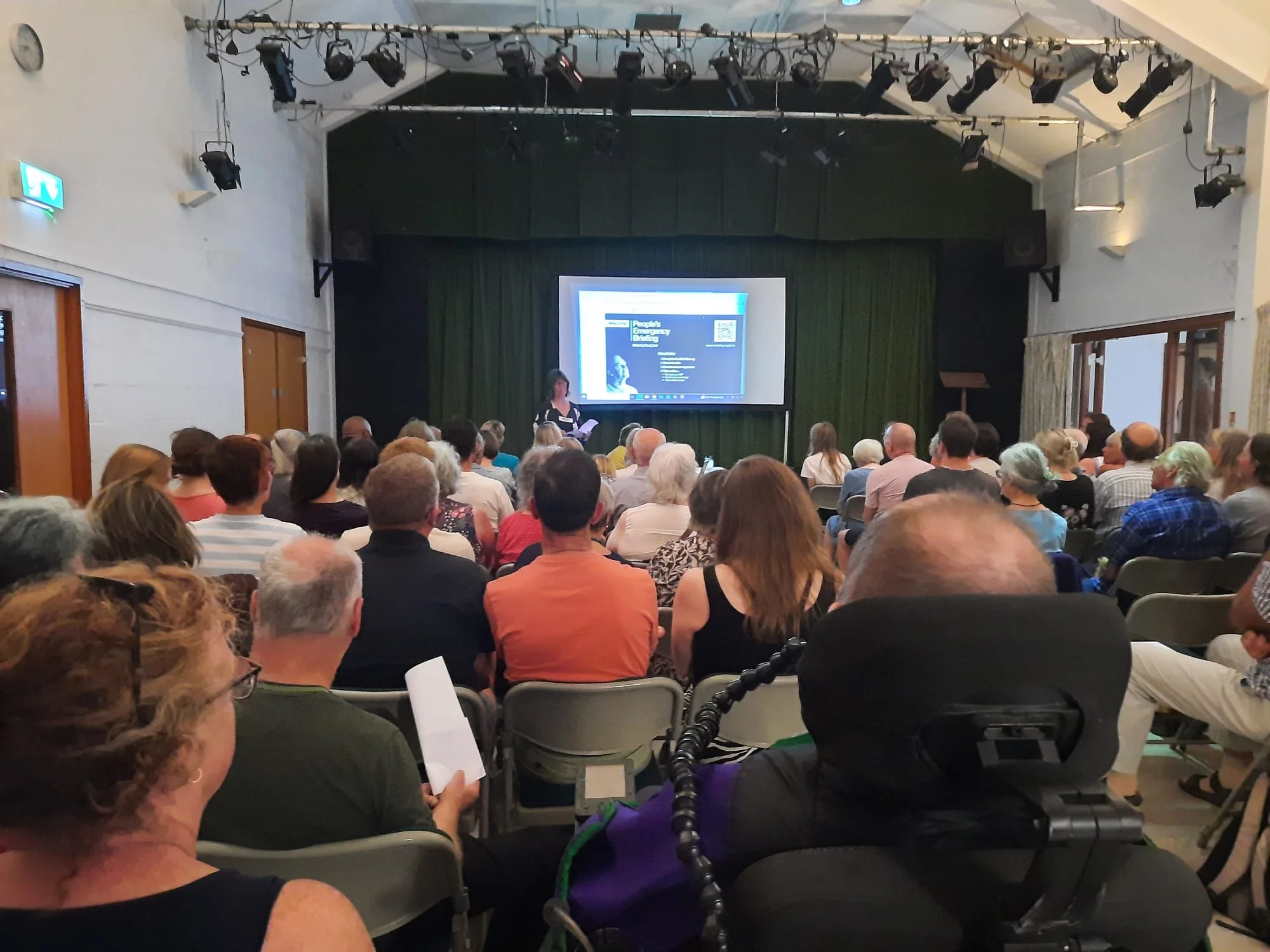
Just one week before our group screened this film at Haslingfield Village Hall, the government responded to a (still live) petition, which arose from the thousands of screenings like ours across the UK, asking for a televised public briefing on the emergency. That response, written by DEFRA and which you can read here, said that the campaign is right to highlight climate change as a major threat. They agreed that “nature and a stable climate underpin our health, economy, national security and critical services.” They also committed to a new “public statement” this summer - their second statement on the subject. The first, called the State of Climate and Nature, came out in July 2025, and they say it got lots of coverage. Do you remember that?
Neither did I, and that’s why it worries me that instead of agreeing to a public briefing, to include all the information in the film, the response dodged the question and sought to reassure us with something called Adverse Weather Health Plans and new food waste and recycling schemes. Don’t get me wrong, those are good steps. But it still seems that the government is acknowledging an emergency while declining to communicate it as such to citizens. That's precisely why people like us matter. But how?
The film brought a lot of information together into one hour. It’s hugely impactful and from the discussion afterward I think most of the people there felt that impact. But I also suspect most of them already knew at least the outlines of what this film had to say. As Chris Packham said, 83% of us consider climate action urgent. So what the film gave me, especially on this second viewing, isn't primarily information. It's the experience of knowing this together, in a room, with other people. And that is rarer and more important than it might sound, because we live in a culture that has become very good at keeping this knowledge private. We carry it individually. We manage it individually. We imply that it's an individual problem of behaviour change or better choices. We have almost no shared language for it in ordinary life — at work, at school, and perhaps even at home.
But even sharing that knowledge with others isn’t enough. For me it feels imperative that we get from information to action. And again, we’re better off doing that together. The writer Rebecca Solnit tells the story of being at an event in Paris during the climate treaty negotiations, sitting on the floor with science writer Bill McKibben, when someone came up and asked him "What's the most effective thing I can do as an individual?" McKibben replied: "Stop being an individual. Find something to join. Join an organisation, a movement, a campaign. Find a community."
This was literally the first step I took when I decided to “do something”. I researched what was already going on in Cambridge. And that’s even easier now that we have a Cambridge Resilience Web site where you can find in one place all the local organisations working on climate, food, equality, reducing waste, nature restoration, plastics, etc. etc. Many of them would love your volunteer energy or, if that’s not possible, your financial or “getting the word out” support.
But we can also make use of the communities we are already part of. In Haslingfield, our parish council is already trying to be part of the solution, as are this and many other groups and individuals locally (check out our WhatsOn and Projects pages to see what we are doing). Maybe you can form your own new action group with your friends and neighbours – a car sharing, or walking to school, or plastics reduction group. Maybe that can start with attending our follow up get together on Sunday July 19th, at Wisbey’s Yard Community Room, CB23 1NF, from 6 to 7.30pm. Anyone who has seen the film or the full public briefings on YouTube is welcome. Do please let us know if you plan to come by writing to hnheco@gmail.com.
On the night, there were several comments from the audience that expressed feelings close to despair. Weirdly, after 11 years working and learning in this space, I have been feeling more optimistic lately. There is no doubt our situation is dire and dangerous, and there are consequences we now cannot stop – but the UK has weathered dangerous times before, with a spirit that I’m sure we still have within us. I don’t know what the one big beautiful solution is – I don’t think there is one – but I know that the only thing that guarantees a bad future is failing to act now. We can make a difference — a real one — that could contribute to something beautiful eventually. But we have to get to work.
PS: The filmmakers responded to the government's response, by the way (see it here). Key takeaway: "The government's response lists a range of reports, plans and strategies. These are valuable documents, but they are not a substitute for clear public communication. The central issue is not whether information exists, but whether it is reaching the public."