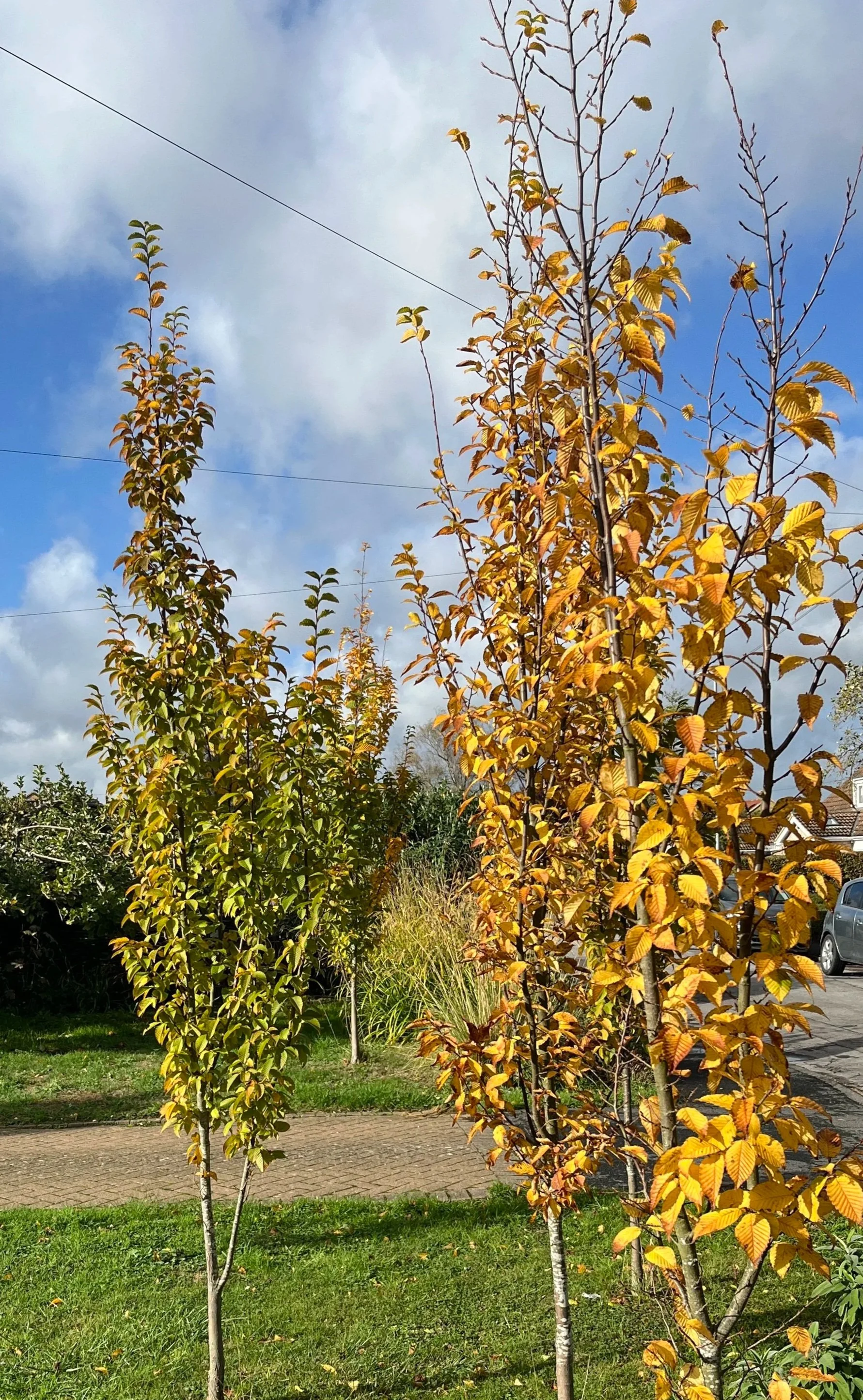
Young Hornbeam trees
We planted these hornbeams about 8 years ago, because I loved this UK native tree’s bright autumn colours, plus they tend to grow straight up rather than out so I could squeeze a little hornbeam wood in my front garden. But I feared for their lives in the heat and drought of this past summer. We lost at least one of our young silver birch trees in the back garden and I saw other trees in the village that were clearly struggling. Here we are at the end of October, though, and they look just as I hoped they would - on fire with eye-catching yellows and oranges. And isn’t it amazing how quickly the green returned once we got a bit of rain - proof of the resilience of nature, which has been through many climactic changes in Earth’s long history!
But the news continues to be worrying. Some good news - the far right defeated in Brazil and Serbia, an Olympic bid for the North of England, UK renewable electricity generation reaching a new record share of 55.8 percent of generation, according to the government’s June 2026 Energy Trends Report. But also some horrifying news, especially from Palestine, Ukraine and Yemen. And lots of confusing news. Whose ally is the US now? How at risk are our pipelines and national grid? Should we be prepping? And how is this Super El Niño thing going to pan out?
On that last question I have some information. Last month I attended a seminar on the effects of the El Niño led by Professors Hayley Fowler and Paul Behrens and learned a lot. Below are my takeaways:
El Niño is a naturally recurring (~every 2-7 years) climate pattern that occurs when sea surface temperatures in the central and eastern Pacific Ocean become warmer than average. It is well understood, as are its typical effects - heavy rainfall and coastal flooding in parts of Ecuador and Peru, droughts in Indonesia, Australia, northeastern South America and southeastern Africa, warmer than usual weather in parts of northern Asia and northern North America, reduced hurricane development in the North Atlantic and increased hurricane development in the eastern Pacific. (https://www.britannica.com/science/El-Nino).
However, this El Niño is the largest (that is, warmest ocean temps) ever recorded by quite a bit. El Niño is declared at a temperature anomaly of 0.5 degrees C - this one is forecast to be 4-5 degrees C. It is also coming on top of global warming which has already reached about 1.5 degrees. While its effects are separate from the effects of climate change, the two phenomena could amplify each other’s impacts.
BUT! Since it is so record breaking, scientists are wary about making predictions. Will it create the same effects, only stronger? New and different effects we haven’t seen before? Will it affect the same places, or will other regions also feel the impacts?
The phenomenon will peak in November or December and carry on through early 2027.
The UK is a long way from the Pacific Ocean, so it is not normally significantly affected - at least not directly. However we may see more, wetter, and stronger storms - as I write, the cleanup from Storms Austen and Boelo, which brought flooding and power cuts to thousands in the UK, is ongoing. And it depends what you mean by significant - during the last El Niño in 2023-2024, high rainfall caused poor harvests and our farmers are already struggling due to drought and high input costs.
Thus, the most significant effects for the UK may centre around food - disruptions to certain food crops we import, such as cocoa and rice, or another year of poor local yields, may mean prices will continue to go up right through 2027 and beyond.
Which brings us to prepping again! Three ideas I’ve heard on that appealed to me. Firstly, if you have the space and income to purchase and store canned and dried food, batteries and torches, camping stoves and firewood (if you have a fireplace or stove), than fantastic. But consider that many people have neither, even in our community, so perhaps think of it less as prepping for your own family alone, and more as prepping for the community. Hopefully any outage or scarcity will not last long (government is advising 3-4 days worth of supplies, including water, pet food, baby formula and medications), so the important thing will be to get all our residents through unscathed. Secondly, don’t buy foods you don’t eat. Buy your regular canned and dried staples, in slightly larger quantities, and as you use them, top them up. Finally, if you have the space, store tap water in any large, clean glass or plastic bottles which you might normally put in the recycling. It doesn’t go off and it’s a heck of a lot cheaper than buying bottled water.
Those are my thoughts - I’d love to hear yours! Please comment below with your ideas and reactions.
Michelle Golder
CoW