Optimism is Hope with a Purpose
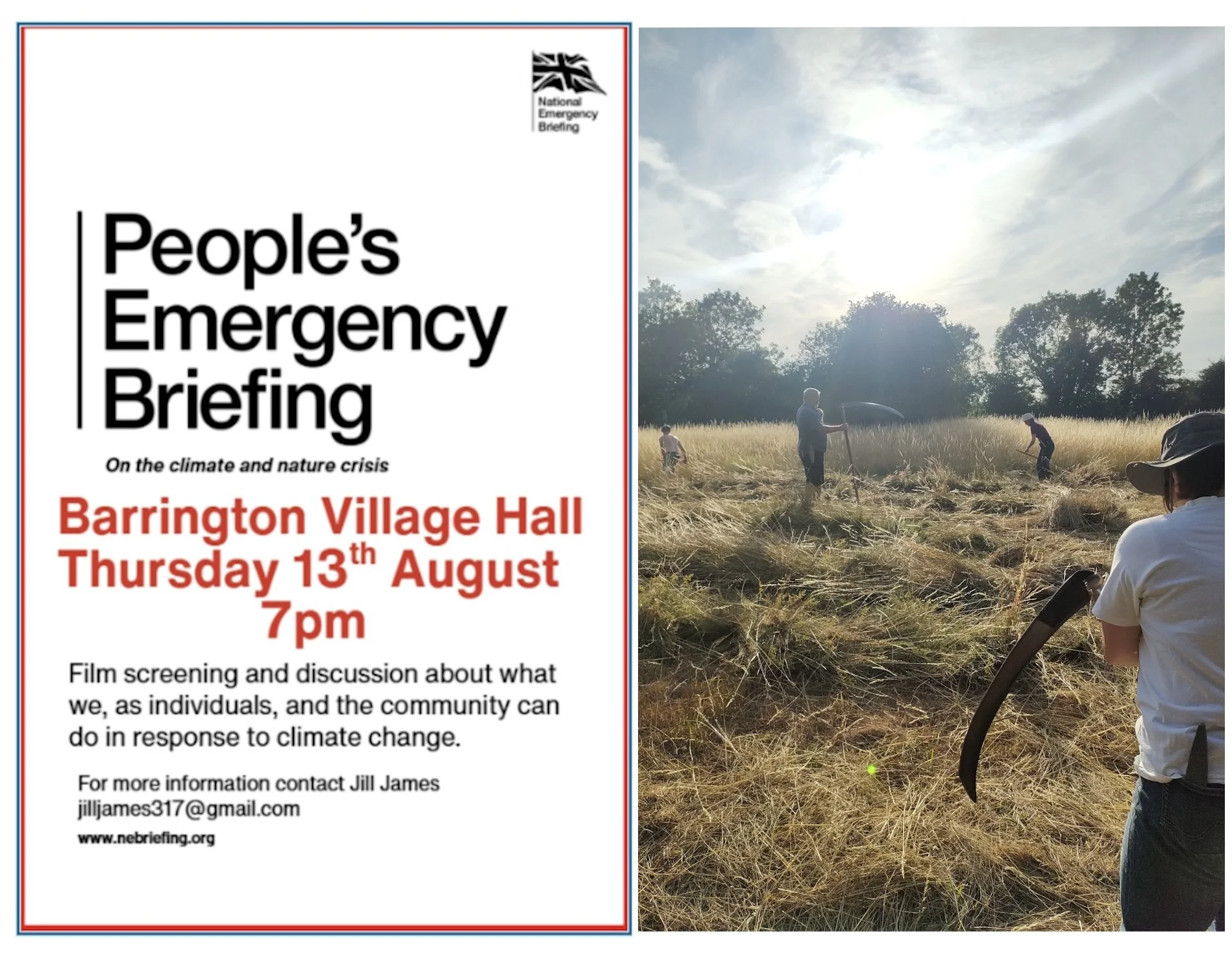
A poster for Barrington People’s Climate Emergency Briefing film, next to a photograph of people scything in a golden field at sunset.
I will be part of a panel at a screening of the People’s Emergency Briefing film this Thursday at Barrington Village Hall. This will be my third time seeing the film, but the first time seeing it in the context of what seems to be a Northern Hemisphere inferno the like of which we haven’t seen before. It’s hard to figure out what to say in a context like this. People want reasons to have optimism – and if optimism means motivation to do something there are loads of reasons to have that. If it means thinking everything is going to be fine, though, I’m not onboard. I’m convinced that what it will be, at least at local scales, is what we allow it to be.
One observation worth making is that the degree of atmospheric warming we are now experiencing tracks very well with the predictions scientists have been making for decades. After all, the science of the greenhouse effect is very simple. What scientists couldn’t predict so confidently is what the impacts of ~1.5 degrees above pre-industrial levels would be. The severity of those at this degree of warming has taken some scientists by surprise. (For my references for the statements above, see https://drawdown.org/insights/is-climate-change-unfolding-faster-and-fiercer-than-scientists-expected. I promise it’s a very reputable source.)
But we should be kind of glad the climate scientists have proven themselves to be so accurate, because they are still saying we have the solutions to this problem and that once we stop emitting temperatures will pretty quickly stop increasing (NB – they won’t come back down for a very long time, but they won’t keep getting hotter. Hopefully.) And the UK has done quite well at decarbonising our grid. Renewables generated a record 52.5% of UK electricity in 2025 – 64.8% if we include nuclear. Current government targets should get us to 77-95% clean energy by 2030. That would put the UK ahead of almost every major economy in terms of grid decarbonisation. We’re a small country, relatively speaking, but in terms of this metric, we are doing our bit. That said, home and building decarbonisation numbers are not so good. Too many UK homes are still poorly insulated and heated by gas or oil - but that’s an example of something that – to an extent at any rate– is over to us. You and me.
What else is in our ballywick? After 11 years of activism, research, reading, talking, listening, here’s my thoughts.
1) Hope and optimism are not things that exist in the ether. They are things that you and I help build – or help destroy.
2) Optimism could be defined as hope with a purpose. I can hope that my village will decarbonise, or I can take steps to help. I can hope that politicians will take the appropriate action, for I can hold them to account for what they do. I can hope that farmers will grow enough food for us all despite the drought, or I can start growing some of my own. I can hope that people will reduce their consumption, or I can volunteer at a local repair café (even if it’s just to bake cakes!)
3) “Global climate” is a simplification. There have always been local, seasonal, regional and micro-climates. Humans affect these. UK cities have been recorded as up to 5°C warmer than surrounding rural areas at night. Trees, hedges and meadows cool the soil and affect the water cycle, even at a micro level. Destruction of the Cambridgeshire Fens wetlands changed the local climate, by removing the standing water and saturated peat which had moderated temperature swings and buffered frosts, long before anyone was thinking about carbon. So what you do in your garden, your drive, your school, potentially in your job if you can have an effect on landscape, and in your local community, can make a big difference.
4) Don’t just accept change – seek it out. The one sure thing I think I know is that the future is not going to be like the present. Climate change, AI, changing demographics, climate refugees, massive challenges to how we produce food and what we eat, all of these are products of a system that is no longer working. I get so bored when I hear politicians or activists using 20th (or 19th!) century terms and ideas for the changes we need. I look forward to new ways of thinking about how we organise society. Public assemblies? Bring em on. Youth councils? Great idea. Rights for rivers, trees and fenlands? Sounds good. We can be a part of helping those happen (trying them out, as it were).
5) Find out what’s already going on. This was my first step, back in 2015. I researched groups in Cambridge working on climate change. There were loads, from a very active student group at Cambridge University, to Cambridge Carbon Footprint and Transition Cambridge. Not to mention the various university departments, which you can connect with to read articles, attend lectures, and get a good picture of the latest research and developments. And of course I didn’t just find groups working on climate – there are also loads looking at nature, and that led to a whole new avenue of discovery for me about the relationship between the earth’s systems and human inputs.
6) Teach your children and grandchildren to care for the nature and belong as part of it (including by not polluting it with greenhouse gases!). And don’t be afraid that you don’t know enough. I’ve always loved insects but only started taking an interest in wild plants about 5 years ago. During that time I’ve been through all the stages – not knowing anything, thinking I knew more than I knew, realising that there was actually masses I didn’t know, to where I am now – knowing a bit, learning more every day. I can’t wait to discover new things with my granddaughter – and I love sharing the bits I do know with local children through volunteering with the scouts and cubs and forest school.
7) Accept that it’s not all up to you. This one has been very hard for me (which probably shows that I’m a bit of a narcissist or something, so please ignore if you’re going, I never thought this!). I’ve always liked solving problems, and looking at the big picture, but the scale and complexity of the problems we are facing is mind-boggling. I’m struggling to accept that the situation in America is not something I can change, for example, and to tune it out. Every day I have to ask myself – is this something you can do something about, or are you just worrying a bone that won’t chew? And then go back to the things I can change.
8) Talk about it. Possibly the hardest thing on this list. I used to raise the topic with everyone from my hairdresser to the binmen, but weirdly, my recent experience has been with people who have pigeonholed me to tell me they don’t believe in climate change (because they know I’m the local climate change nut, presumably). I used to try to convince people, and spew out facts and figures. Sometimes I still can’t stop myself. But 100% my best advice on this is to ask questions and then listen. And not aggressive questions (Why do you deny science?) but open questions – Why do you think that? Where did you learn that from? Does your family agree? Why do you feel that way? There’s usually something we can agree on. I then respond with my own feelings if I think it’s appropriate. But I try to stay calm, not get angry, not get upset, and give people the dignity of making their own minds up. And these conversations have actually changed people (both sides, by the way). Examples are available if you’d like to talk to me about it!
9) Do something physical. There are people (including me!) who are trying to restore nature across the UK and they all need more bods to help, but the most important reason is that it makes you feel good, teaches you skills and helps you learn about nature, all while connecting you with like-minded people in your community. It doesn’t have to be a big commitment, either. Cambridge Conservation volunteers, the Wildlife Trust, Cambridge Past Present and Future, the Cambs Scything Workgroup (that’s one I helped set up), the Countryside Regeneration Trust, Empty Common Community Garden…all of these offer opportunities that you can join as and when. Your parish council might also have work it will happily pass on to residents. Oh, and bring your kids!
10) Keep going, face the truth, carry on. As one of my favourite thinkers on this topic, Nate Hagens often says, climate change is not a problem, it's a predicament. Problems have solutions — apply the solution and the problem goes away — but predicaments don't have a solution; all you can do is respond to them. To give a real life example, a broken bone is a problem, aging is a predicament. Climate change is the reality we and our descendants will all be living with for the foreseeable future. We can make it worse, or we can make it better. What we can’t do is just ignore it.