Tree Planting in a Warming World
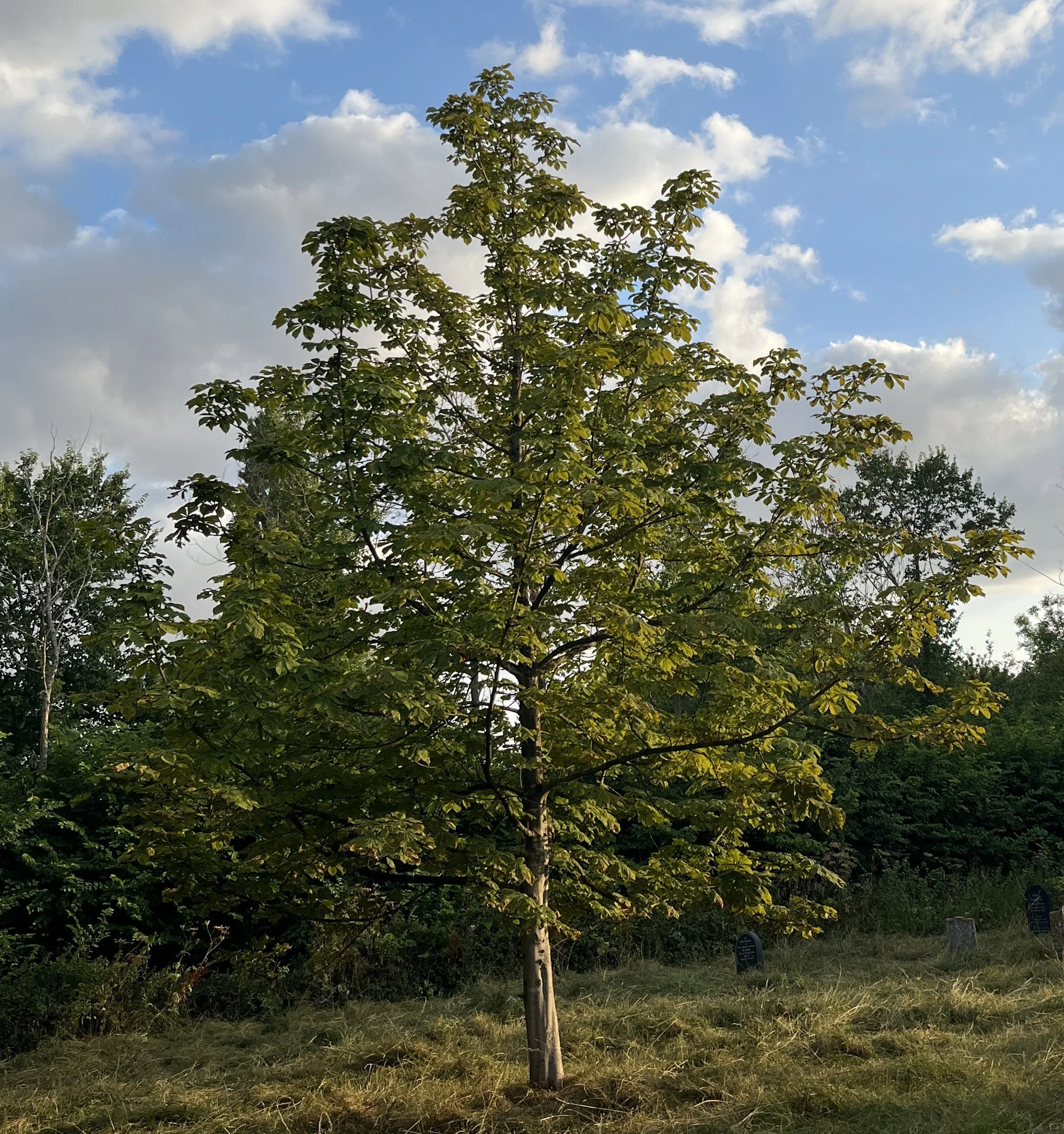
Horse Chestnut Tree in golden light
Trees are essential to the well-being and healthy functioning of many of the environments on earth – not least in the UK, a nation once covered in forest. With their seeds, bark, fruit and leaves, trees provide food and shelter for thousands of living creatures from fungi to insects, birds to squirrels, bats to humans. But their services don’t end there. Trees “breathe in” carbon dioxide, the primary greenhouse gas, and “breathe out” oxygen – in other words, they help sustain our atmosphere. Much of that carbon gets stored in their trunk, branches and roots – effectively drawing down greenhouse gases. They also draw nutrients up from the soil, and then, in a beautifully circular system, the leaves built from those nutrients fall, decay, and feed the soil and the microorganisms anew. Trees also manage water. Their roots bring water from underground where it eventually transpires out to the atmosphere from the tree’s leafy crown. Forests create their own micro-climates in this way – and when they are lost, the climate becomes hotter and drier.
Unfortunately, if we look around our lovely village these days, we see many trees that are under stress. Year after year of unusual weather – high heat and unpredictable rainfall – is taking its toll, and it looks like our existing tree cover may be under threat. In addition to normal tree loss, two mature aspens on the Wellhouse Meadow succumbed to fungal infection, a silver birch on College Crescent had to be felled due to disease, and a magnificent white poplar by the pumping station fell over during high winds. Planting new trees, to compensate, has had only mixed success. Of 15 trees planted by the Parish Council since 2021, only 10 have survived – this is a 33% loss. On a national level, where tree planting schemes are often part of the 10% biodiversity net gain (BNG) targets developers are required to meet, the record is equally dismal. According to information obtained by the Natural World fund, “more than one in five trees planted using taxpayer funding in the UK died during last year’s drought… at least 821,177 saplings — 22% of the total planted — were lost due to prolonged hot and dry weather conditions.”
Even here in the village, trees planted by developers are failing. A large silver birch planted on New Road a few years ago died in the summer after planting and remains in place, a sad reminder of good intentions gone wrong. At least one other tree on a recent development on the same road – again a large young tree – is looking unhealthy, its leaves yellowing and crisp. It is unlikely to survive. And this is at only about 1.46 degrees of warming – some models are pointing at 2 degrees by 2040.
Why tree planting has become harder – especially in our area
1. Not enough rain - New saplings need roughly 12–36 months of adequate root-zone moisture to establish. In the past, trees planted in autumn received plenty of winter and spring rain before having to deal with summer temperatures. But that is changing fast. Our area has been experiencing water stress for 10 years now – see the timeline at the bottom of this article – and the trajectory is for more and more climate disruption.
2. Too much heat –
· Research into the 2021 Pacific Northwest "heat dome" (Still et al., Oregon State University) found that a large share of tree damage wasn't drought-driven at all — it was direct heat scorch on exposed foliage. This means watering alone cannot guarantee a young tree's survival if it is planted in full, unshaded exposure. A young tree planted in an open, south-facing spot is the most vulnerable to this — it has no neighbours to provide shade. The same study also noted that “heat waves are not just associated with droughts, as is commonly assumed, but are increasing in frequency during both wet and dry conditions.”
· Two other studies, one on pear and quince and one on tomatoes, showed that it wasn’t just leaf scorch causing problems for plants – high soil temperatures also cause damage, particularly where surrounding soil is bare or planting area is in direct sun.[i]
3. We may need to rethink which species we plant – A study carried out by Kew Gardens flagged beech, silver birch, English oak and holly as British natives highly vulnerable to heat/drought stress, and warned that it expected to lose a full third of its collection to climate change. For non-natives, Forest Research identified sycamore and sitka spruce as particularly vulnerable. The campaigning group Trees for Cities recommends increasing the diversity of tree planting, and including some drought and heat tolerant non-natives, such as gingko, in the mix.
How to plant: practical recommendations
● Avoid solitary trees in open, full-sun positions. This is the single highest-risk configuration under both drought and direct heat-scorch mechanisms. Instead, site with existing shade or shelter in mind — plant into or adjacent to existing canopy where possible.
● Cluster or nurse-plant rather than space out. UK trial data (Trees Outside Woodlands project, 2024) found densely-planted "Miyawaki-style" plots had 79% survival vs 47% for conventionally spaced control plots, even through the 2022 drought — partly because trees shade and moderate microclimate for each other.
● Mulch heavily and use watering tubes/bags at planting to reduce evaporative loss and cool soil.
● Source from warmer provenance where appropriate — e.g. oak grown from more southerly-sourced acorns (mid-France), an adaptation already being recommended nationally, keeping the species native while shifting to a better-adapted gene pool.
● Plan for the water source, method and responsibility before planting.
● Plant young – ideally one or two year old whips at the oldest. The larger the tree, the more water it needs in its first years.
● Use a biodegradable/recyclable protection sleeve. For example, this company produces both options. Products can be purchased from online gardening suppliers. https://tubex.com/products/
Species selection
Reliable natives (drought/heat tolerant)
● Field maple
● Hawthorn
● Small-leaved lime
● Rowan
● Sorbus, including wild service tree (Sorbus torminalis) and Whitebeam
● Oak sourced from Mediterranean stock (same species but more resilient)
● Yew
Non-natives with strong resilience data
● Swedish whitebeam (Sorbus intermedia) — the Sidney Gardens specimen is a well-chosen tree: consistently described as highly drought-, wind-, and pollution-tolerant once established.
● False acacia (Robinia pseudoacacia) – there is a healthy one in the Wellhouse Meadow
● Turkish hazel (Corylus colurna)
● Holm oak (Quercus ilex) — evergreen, Mediterranean, though supports fewer associated UK invertebrates than native oak
● Mulberry (black and white - avoid chalk soils)
● Gingko
● Olive (not tolerant to cold though – needs sheltered spot)
Bad News about cherry
● Bird cherry (Prunus padus) is native but genuinely moisture-loving, not drought-adapted — best sited with reliable moisture rather than full, exposed sun
● Cherry and other Prunus species are more heat/drought-sensitive than many alternatives, and stress increases vulnerability to disease
Appendix: East Anglia Water Stress Timeline
2016–2019
East Anglia declared an official drought in May 2019, after three years of exceptionally dry weather across the southeast (Cambridge Independent, "Picturesque for how long?)
2020
East Anglia moved into prolonged dry weather status - one tier below full drought - for the Cam and Ely Ouse area.
2021
East Anglia formally classified seriously water stressed by the Environment Agency (ENDS Report, July 2021), despiteextreme rainfall and flooding at the start of the year - illustrating the swing between flood and drought that climate instability causes.
2022
July was England's driest since 1911, with East Anglia among the most extreme areas nationally.
2023/24 winter
The one clearly wet winter in the recent record — 8th-wettest UK-wide, with February 2024 hitting 248% of the long-term average rainfall for East Anglia specifically. Attribution science found this rainfall was about 20% more intense and roughly 10 times more likely because of climate change (WorldWeatherAttribution.org).
2025
· The February–July 2025 six-month dry period was the third-lowest in Anglian Water's records going back to 1899 — beaten only by 1976 and 1921. (BBC, "Water firm urges caution in driest spell since 1976")
· 2025 was England's hottest summer on record, and one of its driest springs.
· East Anglia was the last region in England to return to "normal" status, on 23 March 2026.
2026
· East Anglia moved back into prolonged dry weather by June, just weeks after recovering.
· Cambridge Water announced its first hosepipe ban in over 30 years, effective 17 July, citing demand up roughly 30% (86 to 112 million litres/day) against one of the driest springs on record.
[i]Pear/quince root-zone heat study:
https://doi.org/10.3390/horticulturae11111337
("Effects of High Root-Zone Temperature on the Physiology and Growth of Pear (Pyrus communis L., cv. Bartlett) and Quince (Cydonia oblonga Mill., cv. BA29) Plants," Horticulturae, 2025)
UC IPM extension note on thermal injury (root and canopy):
https://ipm.ucanr.edu/home-and-landscape/thermal-injury-or-high-temperatures/